Cortisol test: is it your cortisol, your testosterone or burnout?
We advise against this test for stress, burnout or fatigue. Order it only if your doctor asked for it.
We advise against this test
If you are looking for this test because of stress, burnout, fatigue or weight gain, we advise you not to order it. A single cortisol measurement cannot answer that question: your cortisol has to roughly double before any change is even detectable, and the contraceptive pill, pregnancy, night shifts and even the stress of the blood draw itself shift the result. We sell this test only because a doctor sometimes asks for it. Read below why, and what does help.
Add to Cart
No referral needed
Added to your cart
Click the button to view your cart
Biomarkers Included
1 biomarkersYou are probably here because you are tired, recovering worse from training, putting on belly fat, or noticing your libido has gone. And somewhere along the way you read that cortisol suppresses your testosterone, that your testosterone-to-cortisol ratio is off, or that your adrenals are shot. So you want your cortisol measured.
We do sell that test. But we will be honest about what you get for it: one number that does not answer your question. There is exactly one good reason to take it, and that is that a doctor asked for it. If you are here because of stress, burnout, fatigue or a suspicion of low testosterone, we advise you not to order it. Below is why, with the sources, so you can check it yourself.
What cortisol is, and what the test is genuinely for
Cortisol is a hormone made by your adrenal glands. It helps keep your blood sugar steady, helps regulate how your body responds to strain, and follows a strong daily rhythm: high in the early morning, low around midnight.
Measuring cortisol is a real, recognised test. Doctors use it to detect two rare conditions: Cushing's syndrome (too much cortisol) and adrenal insufficiency, or Addison's disease (too little cortisol). These are serious illnesses, and for that question the test is essential.
But look at what the test actually involves. The Endocrine Society guideline prescribes: two late-night saliva samples, two 24-hour urine collections, or a dexamethasone suppression test where you take a tablet the night before. None of these is a blood draw you can simply walk in for. For Addison's disease, a morning blood draw between 06:00 and 10:00 is a legitimate first step, but only alongside ACTH, and only when a doctor already suspects the disease.
What the test is not: a gauge of how hard your life is, how hard you train, or how your testosterone is doing.
Why one blood draw cannot answer your question
This is the core problem, and it is arithmetic, not opinion.
Cortisol fluctuates enormously, even in healthy men doing nothing unusual. Clinical chemistry calls this the reference change value: how much a value must change before you can say with 95% confidence that something genuinely changed. For cortisol in blood, that is around 47%. For salivary cortisol it runs to 96 to 245%, depending on the time of day.
Put plainly: your cortisol has to roughly double before anyone can even establish that anything changed. Everything below that is noise. We could draw your blood twice, an hour apart, and get two numbers tens of percent apart, both entirely normal, and both meaningless.
On top of that, the things that shift your cortisol are precisely the things this audience brings with them:
- a heavy training session or an intense week at work shortly before the draw, temporarily pushing your value up
- night shifts, shifting bedtimes and too little sleep, which overturn the daily rhythm the test entirely depends on
- alcohol, which affects how your body regulates cortisol
- corticosteroids (prednisone, dexamethasone, including creams and inhalers), which suppress your own cortisol production
- the needle itself: the stress of a blood draw raises your cortisol at the very moment you measure it
So you are not measuring your "stress level". You are measuring where your cortisol happened to be when the needle went in.
Is it low testosterone, or are you burned out?
This is the question most men here are sitting with. And the honest answer is: a cortisol test does not answer it. Not partly, not as a hint. It simply cannot.
The direction of the cortisol effect is not even settled. The largest meta-analysis in this field pooled 147 studies of the cortisol response on waking. What came out: with job stress that response goes up, while with burnout and exhaustion it goes down. Two opposite directions, in the same measurement, in people who both say they are spent.
And then the strongest study actually arguing for cortisol as a burnout marker. It found higher midday cortisol in burnout patients. Exactly the reverse of the story you read everywhere, which is that exhausted adrenals make less cortisol.
So one number cannot possibly separate "stressed" from "burned out" from "nothing is wrong". A systematic review of 31 burnout studies covering 38 different biomarkers summed it up: no potential biomarkers for burnout were found. Not one. Cortisol included.
The same goes for "adrenal fatigue", the term you meet next to almost every cortisol test on sale. That condition does not exist. The term was coined in 1998 by a chiropractor, not a doctor. A 2016 systematic review searched 3,470 publications, kept 58, and found no substantiation whatsoever. In most fatigued participants, the cortisol measurements were simply normal. The Endocrine Society is blunt: no scientific proof exists, and there is no test that can detect it.
This is not only wasted money. The supplements sold alongside it can cause harm. A study in Mayo Clinic Proceedings tested twelve over-the-counter "adrenal support" products: all twelve contained thyroid hormone that was not on the label, and a quarter contained a steroid. Taking adrenal hormones you do not need can suppress your own hormone production.
The testosterone-to-cortisol ratio: a number with no cut-off
The testosterone-to-cortisol ratio (T:C) comes from sports science, where researchers used it to try to tell whether an athlete was becoming overtrained. It never became a clinical test, and there is a reason for that.
There is no validated cut-off. There is no number below which you have "a bad ratio", because nobody has ever shown what that number should be. There is also no outcome evidence: no study showing that men with a lower ratio are measurably worse off, or that anything useful changes if you try to steer it.
And then the arithmetic problem. A ratio inherits the noise of both numbers it is built from. Cortisol has to roughly double before you can say it changed at all. Testosterone has its own daily rhythm and varies from day to day as well. Divide one erratic number by another and you get a result that is even more erratic than either measurement on its own. You could have it done on two consecutive mornings and get two very different ratios, without a single thing having changed about you.
An "off T:C ratio" is therefore not a finding. It is a number you cannot act on, built on a measurement too noisy to build anything on.
What we recommend instead
If you are tired, your libido is gone and you are gaining weight, those are real symptoms, and often they have a real cause. It is just rarely in your cortisol. These are the questions that do matter:
- your sleep, and sleep apnoea above all. Snoring, waking with a dry mouth, dozing off during the day, a partner saying you stop breathing for a moment. Sleep apnoea is common in men, is often missed, and causes exactly this list: fatigue, low energy, less interest in sex
- alcohol, in both quantity and frequency
- your thyroid, a common and treatable cause of fatigue
- your iron stores
- low mood and depression, which in men often show up as fatigue, irritability and loss of libido rather than as sadness
If you want blood drawn, the Dutch primary-care diagnostics guidance (NHG/NVKC LESA Laboratoriumdiagnostiek) starts persistent fatigue with a short list. Short, and for a reason:
- Haemoglobin, and if abnormal your iron stores via ferritin
- CRP, an inflammatory marker
- Fasting glucose, to rule out diabetes
- TSH, your thyroid
And testosterone itself? Unlike cortisol, that is a test with a real protocol. The international guideline prescribes: drawn in the morning, fasting, and repeated if the result is low, and only interpreted alongside your symptoms by a doctor. We are not selling you a promise about what it will show. We are only saying: if your question is whether your testosterone is low, then measure testosterone, not cortisol. That is a test with a pathway behind it. A one-off cortisol draw is not.
If you feel burned out, there is no blood value that demonstrates it. Burnout is a clinical diagnosis your GP makes from your story, and the Dutch guideline on work-related stress and burnout says of additional investigation, literally: "not indicated".
We would rather earn nothing from you than sell you a test that does not answer your question.
When this test is appropriate
There genuinely are situations where measuring cortisol is exactly the right thing to do. If you recognise yourself here, you can order the test below:
- your GP or specialist asked for a cortisol measurement. Then you are here to have the test done, not to diagnose yourself, and we are glad to help
- you already have a known adrenal or pituitary condition and you are monitoring your values
- you use or have stopped corticosteroids (prednisone, dexamethasone, including creams and inhalers), where your own cortisol production may be suppressed. That is a legitimate reason for a doctor to want to see your cortisol
If you order without a doctor's request, book your draw between 06:00 and 10:00 in the morning, fasting and without heavy exertion beforehand. Outside that window your result cannot be compared against the correct reference range.
One thing holds even then: a single cortisol value is never a diagnosis. An abnormal result means your GP has to redo the work properly, with the right test.
Sources
We think you should be able to check what we base this on.
- Nieman LK et al. The Diagnosis of Cushing's Syndrome: An Endocrine Society Clinical Practice Guideline. J Clin Endocrinol Metab. 2008;93(5):1526-40. PMID 18334580. (Explicitly recommends against random serum cortisol.)
- Bornstein SR et al. Diagnosis and Treatment of Primary Adrenal Insufficiency: An Endocrine Society Clinical Practice Guideline. J Clin Endocrinol Metab. 2016;101(2):364-89. PMID 26760044. ("There is no evidence to support the use of random cortisol".)
- Chida Y, Steptoe A. Cortisol awakening response and psychosocial factors: a systematic review and meta-analysis. Biol Psychol. 2009;80(3):265-78. PMID 19022335. (147 studies; the response rises with job stress and falls with burnout and exhaustion.)
- Pilger A et al. Midday and nadir salivary cortisol appear superior to cortisol awakening response in burnout assessment and monitoring. Sci Rep. 2018;8(1):9151. PMID 29904183. (Burnout patients had higher midday cortisol.)
- Danhof-Pont MB, van Veen T, Zitman FG. Biomarkers in burnout: a systematic review. J Psychosom Res. 2011;70(6):505-24. PMID 21624574. (31 studies, 38 biomarkers: "No potential biomarkers for burnout were found".)
- Cadegiani FA, Kater CE. Adrenal fatigue does not exist: a systematic review. BMC Endocr Disord. 2016;16(1):48. PMID 27557747.
- Akturk HK et al. Over-the-Counter "Adrenal Support" Supplements Contain Thyroid and Steroid-Based Adrenal Hormones. Mayo Clin Proc. 2018;93(3):284-90. PMID 29502560.
- Bhasin S et al. Testosterone Therapy in Men With Hypogonadism: An Endocrine Society Clinical Practice Guideline. J Clin Endocrinol Metab. 2018;103(5):1715-44. PMID 29562364. (On diagnosis: fasting morning measurement, repeated if low.)
- Nijrolder I et al. Diagnoses during follow-up of patients presenting with fatigue in primary care. CMAJ. 2009;181(10):683-7. PMID 19858240.
- NHG/NVKC LESA Laboratoriumdiagnostiek. NHG-Standaard Overspanning en burn-out (M110): additional investigation "not indicated".
Frequently asked questions
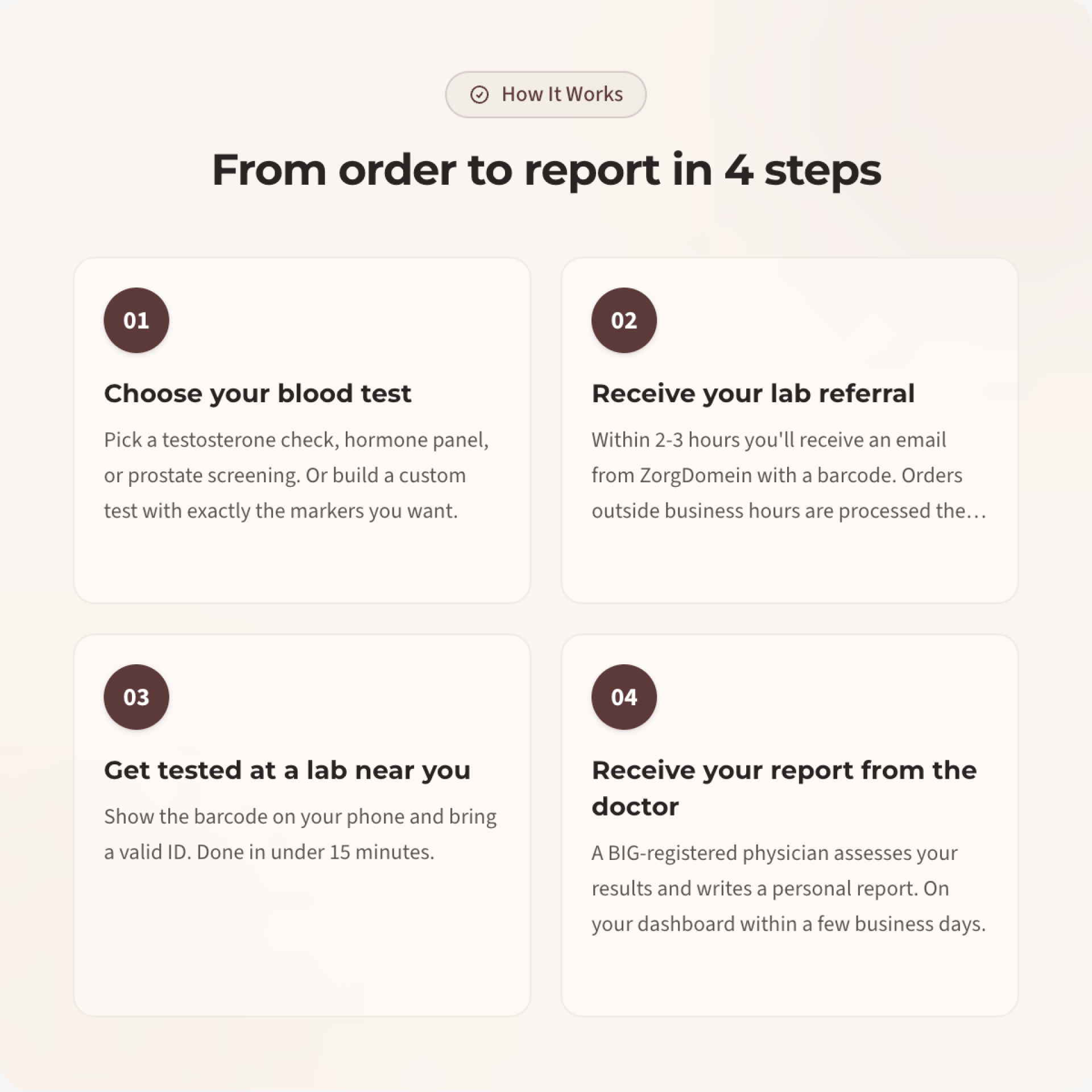
From order to report in 4 steps
No referral needed. No waiting list. Just order and go.
Choose your blood test
Pick a testosterone check, hormone panel, or prostate screening. Or build a custom test with exactly the markers you want.
Receive your lab referral
On the same business day you'll receive an email from ZorgDomein with a barcode. Orders outside business hours are processed the next business day.
Get tested at a lab near you
Show the barcode on your phone and bring a valid ID. Done in under 15 minutes.
Receive your report from the doctor
A BIG-registered physician assesses your results and writes a personal report. On your dashboard within a few business days.
Choose your blood test
Pick a testosterone check, hormone panel, or prostate screening. Or build a custom test with exactly the markers you want.
Receive your lab referral
On the same business day you'll receive an email from ZorgDomein with a barcode. Orders outside business hours are processed the next business day.
Get tested at a lab near you
Show the barcode on your phone and bring a valid ID. Done in under 15 minutes.
Receive your report from the doctor
A BIG-registered physician assesses your results and writes a personal report. On your dashboard within a few business days.
Always a location near you
With 700+ certified phlebotomy points across the Netherlands.
What We Test
This panel includes 1 biomarkers, each tested at a certified laboratory using medical-grade equipment.
Cortisol is the body's primary stress hormone, produced by the adrenal glands. It regulates metabolism, immune responses, and the sleep-wake cycle. Levels follow a natural daily rhythm, peaking in the morning and declining throughout the day.
Learn moreCortisol
HormonesCortisol is the body's primary stress hormone, produced by the adrenal glands. It regulates metabolism, immune responses, and the sleep-wake cycle. Levels follow a natural daily rhythm, peaking in the morning and declining throughout the day.
Cortisol imbalances may indicate adrenal dysfunction or chronic stress. Persistently elevated levels could suggest increased cardiovascular and metabolic risk. Low levels may point to adrenal insufficiency. Consult your healthcare provider for interpretation.
Related biomarkers
Biomarkers often explored alongside this test for a fuller picture.
17-OH Progesterone
17-OH Progesterone is a precursor steroid hormone essential for producing cortisol and androgens like testosterone. For men, monitoring this marker may provide insight into adrenal function and androgen production pathways.
ACTH (Adrenocorticotropic Hormone)
ACTH is a pituitary hormone that directs your adrenal glands to produce cortisol. For men, ACTH levels may reflect how your body handles physical and mental stress, directly influencing energy and hormonal balance.
Androstenedione
Androstenedione is a key precursor hormone that your body converts into testosterone. For men, monitoring this marker may offer direct insight into your testosterone production pathway and overall androgenic hormone balance.
Calcitonin
Calcitonin is a thyroid hormone that helps regulate calcium and bone metabolism. For men, monitoring calcitonin may provide insight into thyroid C-cell health and calcium balance, supporting a complete picture of your hormonal status.
DHEA-S
DHEA-S is an adrenal androgen precursor that supports testosterone production. Monitoring helps men assess adrenal reserve and age-related hormonal decline.
DHT (Dihydrotestosterone)
DHT is the most potent androgen in men, influencing hair patterns, prostate health, and sexual function. Monitoring supports a comprehensive picture of androgenic health.
Related Tests
Explore more tests that might interest you.
DHEA-S Test
Measure your DHEA-S, an adrenal building block for your sex hormones. No referral needed.
Testosterone Test
Measure your testosterone, the main male hormone for energy, muscle and libido. No referral needed.
SHBG Test
Measure your SHBG, the protein that binds your testosterone. Read together with testosterone it shows your hormone balance. No referral needed.
This test not quite right?
Build your own blood test from 139+ individual biomarkers — choose exactly what you need.
Have a question?
Our team is happy to help. Ask your question and we'll respond as soon as possible.