Order a basic health checkup blood test
Key health markers: CBC, lipids, and Vitamin D.
Add to Cart
No referral needed
Added to your cart
Click the button to view your cart
Biomarkers Included
5 biomarkersTriglycerides, LDL Cholesterol, Vitamin D (25-OH), HDL Cholesterol, Basic Blood Count
Never had your blood drawn before, or just due for a refresh? This basic health checkup is a solid starting point.
The panel combines a complete blood count, your cholesterol values and vitamin D in a single blood draw. You order online, need no referral and receive your results within a few working days with a doctor's assessment.
Why this test?
Blood count, cholesterol and vitamin D are among the most frequently measured blood values. This health check blood test bundles them into one draw, so you can look at your blood cells, your cholesterol values and a common nutritional marker in one go.
Vitamin D is one that many men can be low in, especially in winter. It is a clear way to have your blood values tested without committing to a large panel straight away.
Who is this test for?
- Men who want a basic check without an extensive panel
- Men who have not had blood work done in a while and want a starting point
- Men who spend little time outdoors or live in a northern climate and want to check their vitamin D
- Men who want to track their cholesterol values alongside general blood health
You arrange this as a blood test without a referral, so you do not need to see your GP first.
What is tested?
- Complete blood count (CBC): red blood cells, white blood cells, haemoglobin, haematocrit and platelets. Provides an overview of your blood cell production and oxygen transport.
- HDL cholesterol: often called the good cholesterol.
- LDL cholesterol: often called the bad cholesterol; elevated levels may be linked to a higher cardiovascular risk. You can read more on the page about LDL cholesterol.
- Triglycerides: a type of fat in your blood; the level can be influenced by diet, activity and metabolism.
- Vitamin D (25-OH): the primary circulating form of vitamin D, involved in your bones and immune system among other things.
What can this test tell you?
Your blood count can give information about, for example, anaemia, inflammation markers or your platelets. Your cholesterol and triglyceride values can offer context when estimating your cardiovascular risk, together with your lifestyle. Your vitamin D can be relevant for your bones, immune function and general wellbeing.
Together, these markers give you a practical baseline. It is a snapshot, not a diagnosis, that you can discuss with a doctor.
How is the sample collected?
Blood is drawn at a certified sample point. There are 700+ locations across the Netherlands, which you choose yourself after ordering.
This is blood testing without a GP: you pick a location and a time that suit you. The draw usually takes only a few minutes, after which your blood goes to the lab.
When is this test useful?
This basic health checkup can be useful as a routine check, as a first step into blood testing, or when you want to track a few core values without committing to a larger panel. You can order this checkup whenever it suits you and choose your own sample point.
If you would rather look more broadly across multiple systems, the extended health checkup fits that better. It can also be relevant for men who want to track vitamin D seasonally.
What do the results mean?
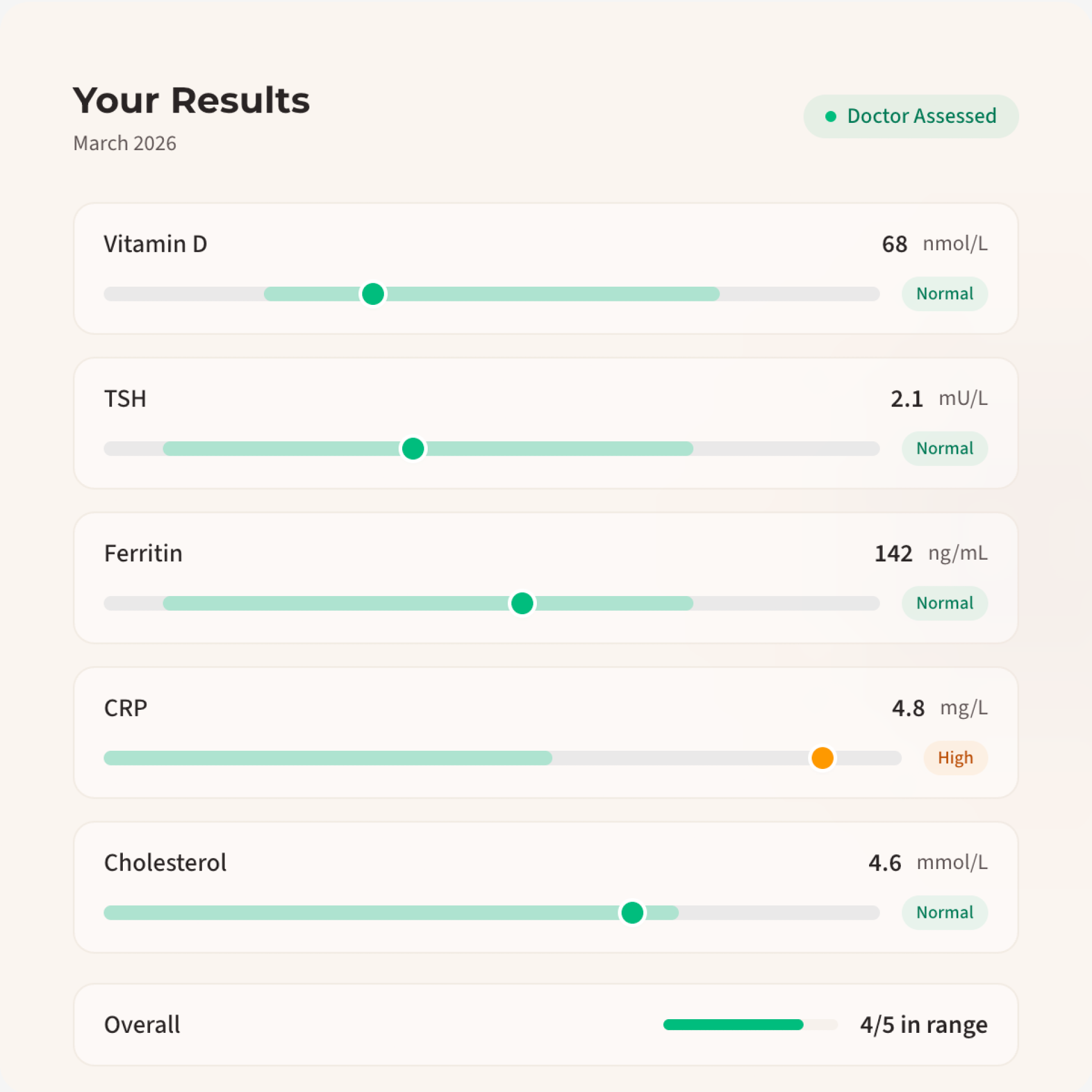
Your results appear with a reference range for each marker. Values outside that range are worth discussing with a doctor, who can place them in the context of your lifestyle, diet and history.
A single out-of-range value does not immediately point to a problem. It is about the whole picture, and sometimes about the trend over time.
What happens after the results?
Your results are usually available within a few working days in your personal dashboard, with measured values alongside the reference ranges. You view them whenever it suits you.
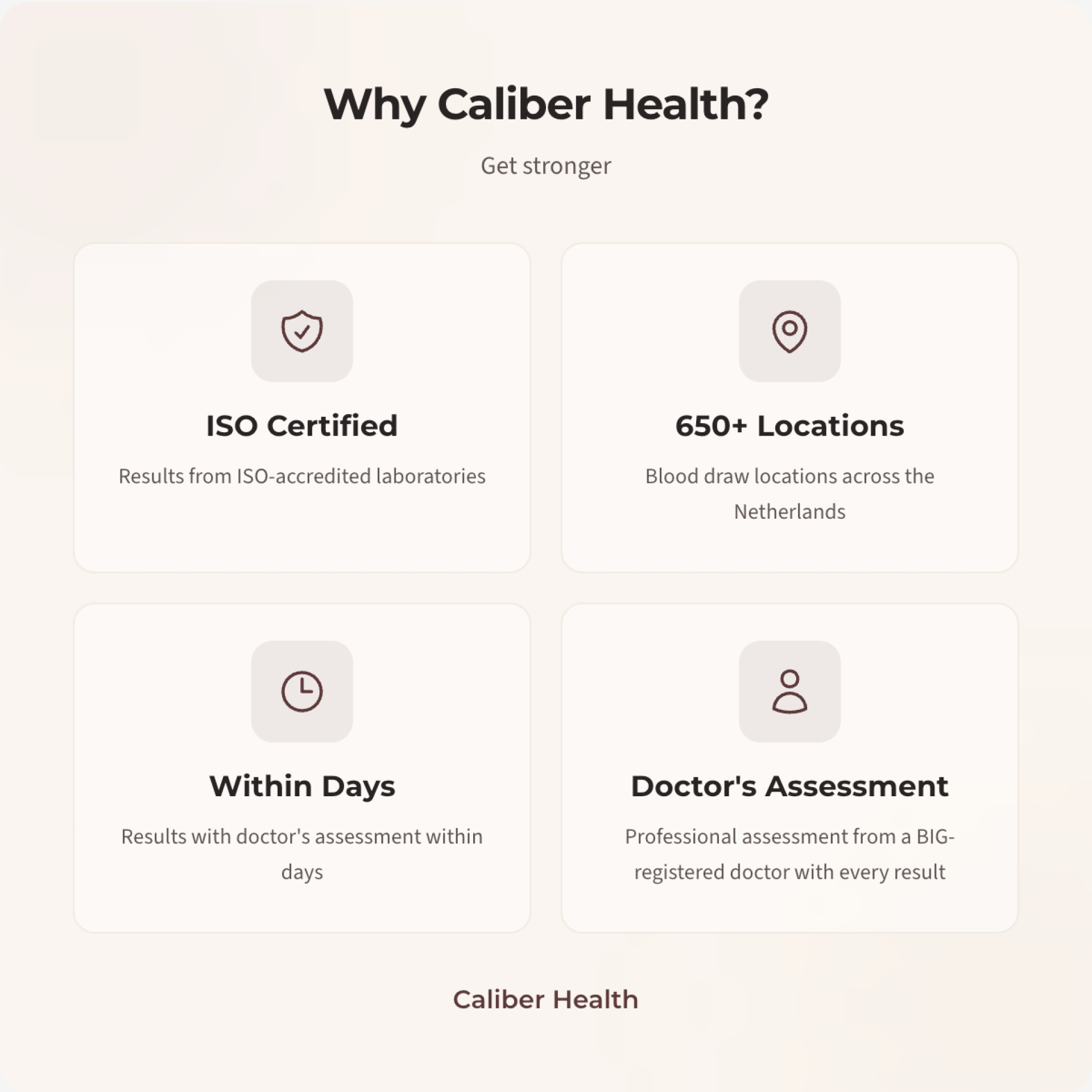
Every blood test result includes a professional assessment from a BIG-registered doctor. For treatment decisions, discuss your results with your GP.
Frequently Asked Questions
For reliable cholesterol and triglyceride values, you usually need to fast for 8 to 12 hours. Drinking water is fine during that period.
This basic check covers a few core values: blood count, cholesterol and vitamin D. The extended health checkup looks more broadly across multiple systems, such as thyroid, liver and kidneys.
No. You arrange this blood test without a referral and choose your own sample point. You can discuss the results with your GP afterwards.
You order the checkup online and then plan your own blood draw at a sample point near you.
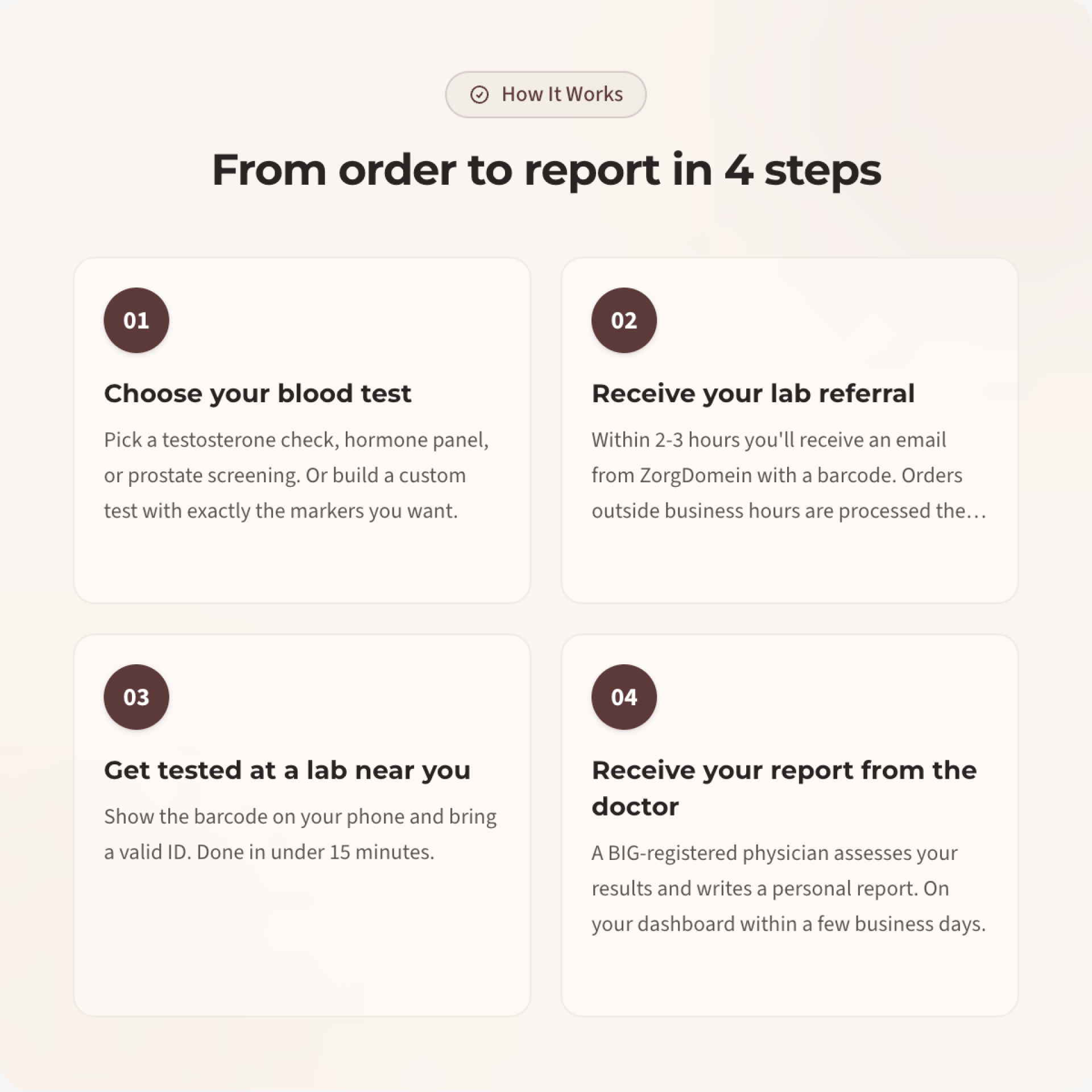
From order to report in 4 steps
No referral needed. No waiting list. Just order and go.
Choose your blood test
Pick a testosterone check, hormone panel, or prostate screening. Or build a custom test with exactly the markers you want.
Receive your lab referral
Within 1 business day you'll receive an email from ZorgDomein with a barcode. Orders outside business hours are processed from the next business day.
Get tested at a lab near you
Show the barcode on your phone and bring a valid ID. Done in under 15 minutes.
Receive your report from the doctor
A BIG-registered physician assesses your results and writes a personal report. On your dashboard within a few business days.
Choose your blood test
Pick a testosterone check, hormone panel, or prostate screening. Or build a custom test with exactly the markers you want.
Receive your lab referral
Within 1 business day you'll receive an email from ZorgDomein with a barcode. Orders outside business hours are processed from the next business day.
Get tested at a lab near you
Show the barcode on your phone and bring a valid ID. Done in under 15 minutes.
Receive your report from the doctor
A BIG-registered physician assesses your results and writes a personal report. On your dashboard within a few business days.
Always a location near you
With 700+ certified phlebotomy points across the Netherlands.
What We Test
This panel includes 5 biomarkers, each tested at a certified laboratory using medical-grade equipment.
| No. | Biomarker | Unit | Turnaround |
|---|---|---|---|
| 01 | Triglycerides Triglycerides are the most common type of fat in the body, used for energy storage. Elevated levels may be associated with increased risk of cardiovascular disease, especially when combined with other lipid abnormalities. | mmol/l | 1 day |
| 02 | LDL Cholesterol LDL cholesterol is the amount of cholesterol carried inside LDL particles, the particles that can build up in the artery wall. That is where its nickname comes from: the bad cholesterol. Two things rarely appear on a report. First, in a routine lipid panel LDL is usually not measured but calculated from your total cholesterol, your HDL and your triglycerides. Second, the 3.0 mmol/l upper limit is a population reference interval, not a target. What counts as a good LDL for you is decided by your overall cardiovascular risk, not by the line printed on the page. | mmol/l | 1 day |
| 03 | Vitamin D (25-OH) Vitamin D is a fat-soluble vitamin. Its main job is the absorption of calcium and phosphate from the gut. That makes it decisive for bone metabolism. The skin produces it under the influence of sunlight. Food and supplements supply a smaller share. | nmol/l | 3 days |
| 04 | HDL Cholesterol HDL cholesterol is the amount of cholesterol carried inside the HDL particles in your blood. Those particles pick cholesterol up from your tissues and from the artery wall and take it back to the liver. That transport is what earned HDL the nickname good cholesterol. The nickname is misleading. HDL is above all a mirror of your metabolism: the value drops with excess weight, insulin resistance, smoking and inactivity, and it is those factors that carry the risk. Drugs that raise HDL substantially do not reduce the number of cardiovascular events. And more is not always better: at very high values, mortality in large population studies turns back upwards. So never read your HDL on its own. It only takes on meaning alongside your triglycerides, your LDL and your overall risk profile. | mmol/l | 1 day |
| 05 | Basic Blood Count A basic blood count measures three core values in your blood: hemoglobin, white blood cells and platelets. Together they say something about oxygen transport, immune defence and clotting. It is a simple baseline check, without the red-cell indices and white-cell differential of a complete blood count. | — | 2 days |
| Your result arrives once the slowest test is finished: 3 days. This is indicative; turnaround varies per laboratory. | |||
Preparation
-
No alcohol beforehand
RequiredDrink no alcohol in the 24 hours before the draw.
-
Preferably fasting
RecommendedComing fasting gives a slightly cleaner value, but it is not required. If it suits you, eat nothing from 22:00 the evening before and drink only water.
- Water is always fine. Drink as usual beforehand, it makes the draw easier.
- Take your usual medication, unless your own doctor told you otherwise.
Extend this panel
Tests from the same field, run on the same sample. Same draw, no second appointment.
Related Tests
Explore more tests that might interest you.
Thyroid Function
TSH, Free T4, and Free T3 for thyroid assessment.
Complete Men's Health Panel
A broad men's health panel: hormones, heart, metabolic, and organ function in one blood draw.
Men Over 40 Panel
Age-appropriate screening including testosterone and PSA.
This test not quite right?
Build your own blood test from 139+ individual biomarkers — choose exactly what you need.
Have a question?
Our team is happy to help. Ask your question and we'll respond as soon as possible.