
Order a PSA test and check your prostate value
PSA screening for prostate health, commonly discussed for men over 50.
Add to Cart
No referral needed
Added to your cart
Click the button to view your cart
Biomarkers Included
2 biomarkersPSA (Prostate-Specific Antigen), Total Testosterone
The prostate is not something men talk about much, but it is worth checking in on now and then. PSA is the marker that comes up often.
This PSA test measures your PSA level and your total testosterone at a certified sample point. You order online, need no referral and receive your results within a few working days, including a doctor's assessment.
Why this test?
PSA (prostate-specific antigen) is a protein made by prostate tissue. The amount in your blood can say something about what is happening in your prostate, although an elevated PSA value is never a diagnosis on its own.
A PSA test gives you a snapshot of this marker. Some men choose to have their PSA measured to record a baseline they can compare later readings against. Because testosterone and prostate tissue are linked, this panel also measures your total testosterone for some added hormonal context.
Who is this test for?
This prostate test may suit men who:
- want to measure and record their PSA value
- have prostate conditions in the family and want a baseline
- have discussed PSA screening with their doctor and want an easy way to arrange it
- want to track their PSA over time alongside their testosterone
You arrange this as a blood test without a referral, so you do not need to see your GP first.
What is tested?
This test measures two biomarkers in your blood:
- PSA (prostate-specific antigen): a protein made by prostate cells. The blood level can be influenced by your age, the size of your prostate, recent physical activity and other factors.
- Total testosterone: the total amount of testosterone in your blood, included for hormonal context alongside your PSA. You can read more about this hormone on the page about total testosterone.
What can this test tell you?
Your PSA value on its own is not diagnostic; it is one piece of information in a larger picture. An elevated PSA value can be linked to benign prostate enlargement, inflammation, recent physical activity or other causes, so it does not automatically fit a single condition.
By tracking your PSA over time, a change can sometimes say more than a single reading. Your total testosterone adds hormonal context. A doctor can best interpret your result together with your symptoms and history.
How is the sample collected?
For this test, blood is drawn at a certified sample point. There are 700+ locations across the Netherlands, which you choose yourself after ordering.
You pick a location and a time that suit you; this is blood testing without a GP, so no referral is needed. The draw is done by trained staff and usually takes only a few minutes. After that, your blood goes to the lab.
When is this test useful?
A PSA test can be useful if you want to record a PSA value as a starting point, or if you want to compare an earlier value over time. Some men have their PSA measured because the topic is present in their family or circle.
If you want to map your hormones more broadly, take a look at the testosterone panel as well. Because a number of everyday things can temporarily raise your PSA, it helps to keep the preparation below in mind around your appointment.
What do the results mean?
Your result shows your PSA value with a reference range that is often adjusted for your age, plus your total testosterone. A value within the expected range is generally considered usual, but PSA interpretation is nuanced.
An elevated PSA value can have several causes and on its own does not mean something is wrong. A change compared with an earlier reading can sometimes be more informative than a single number. Only a doctor can properly put your result in context.
What happens after the results?
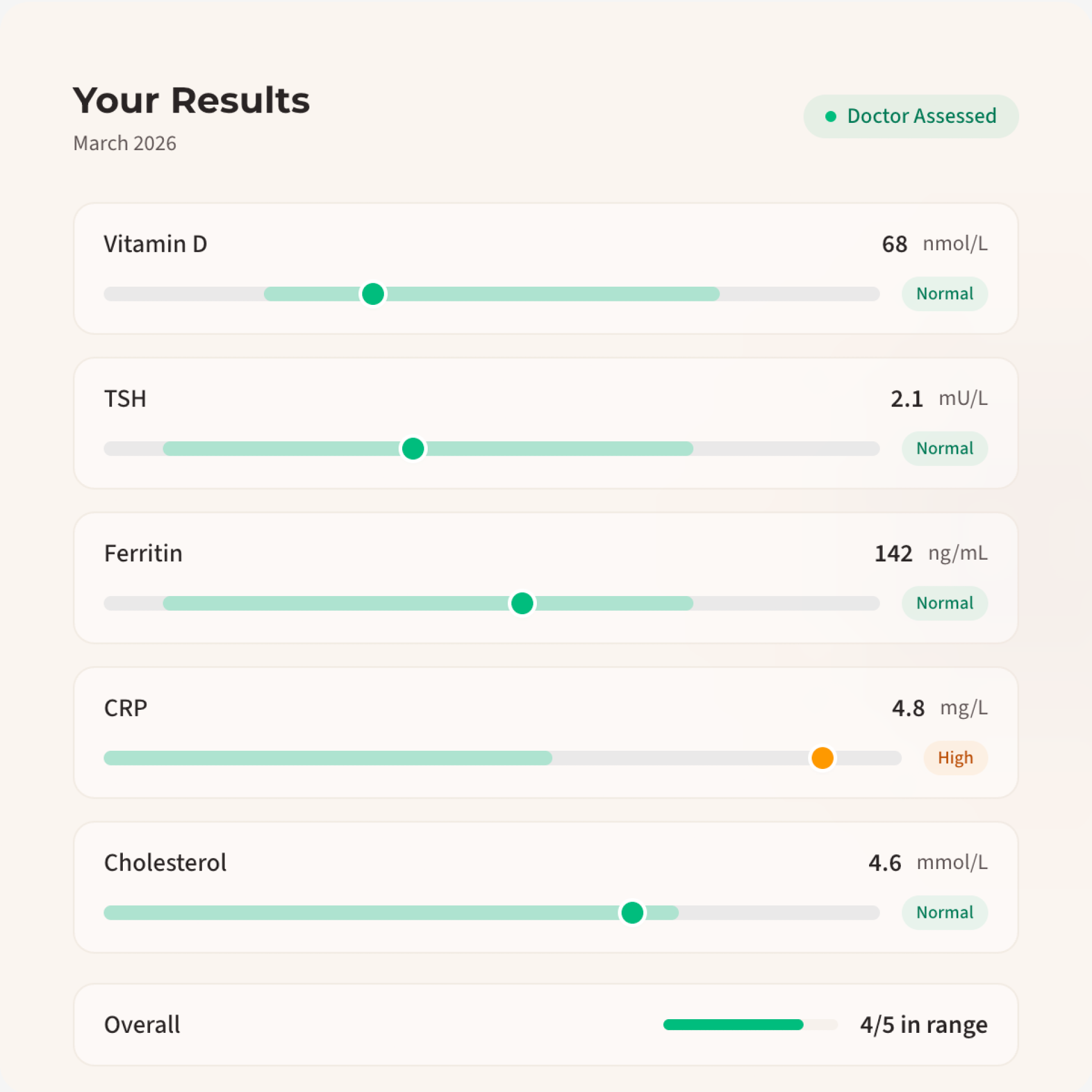
Your results are available online within a few working days. You log in to your account and view your PSA value and total testosterone with their reference ranges and a clear explanation, whenever it suits you.
Every blood test result includes a professional assessment from a BIG-registered doctor. For treatment decisions, discuss your results with your GP.
Frequently Asked Questions
A PSA test measures the amount of prostate-specific antigen in your blood. This panel also measures your total testosterone for hormonal context.
Yes. An elevated PSA value can be linked to benign prostate enlargement, inflammation, recent physical activity or other factors. Discuss a notable value with a doctor.
Many people avoid ejaculation, intense cycling and firm prostate manipulation in the 48 hours before the draw, as these can temporarily raise the PSA value.
No. You arrange this blood test without a referral and choose your own sample point. You can discuss the results with your GP afterwards.
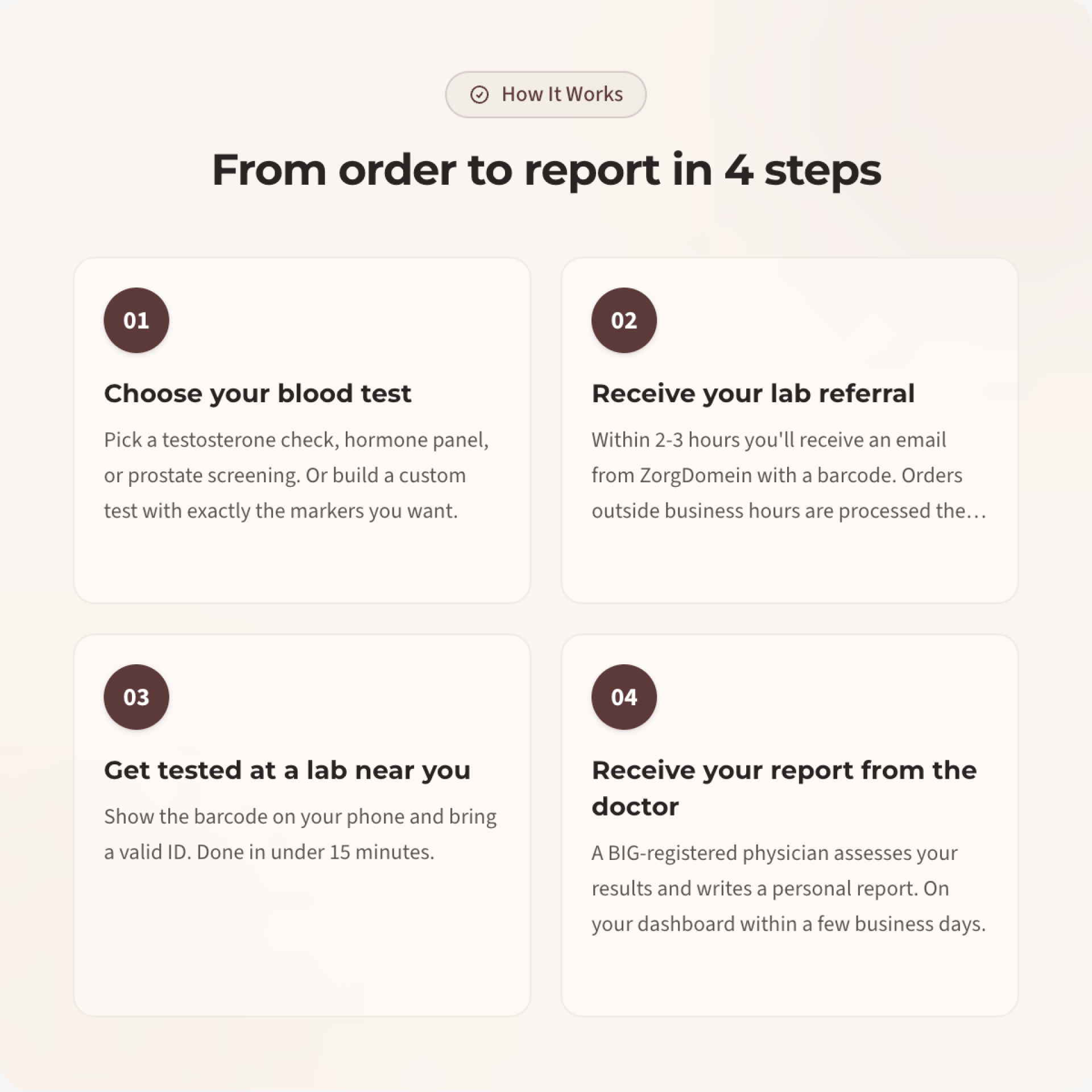
From order to report in 4 steps
No referral needed. No waiting list. Just order and go.
Choose your blood test
Pick a testosterone check, hormone panel, or prostate screening. Or build a custom test with exactly the markers you want.
Receive your lab referral
Within 1 business day you'll receive an email from ZorgDomein with a barcode. Orders outside business hours are processed from the next business day.
Get tested at a lab near you
Show the barcode on your phone and bring a valid ID. Done in under 15 minutes.
Receive your report from the doctor
A BIG-registered physician assesses your results and writes a personal report. On your dashboard within a few business days.
Choose your blood test
Pick a testosterone check, hormone panel, or prostate screening. Or build a custom test with exactly the markers you want.
Receive your lab referral
Within 1 business day you'll receive an email from ZorgDomein with a barcode. Orders outside business hours are processed from the next business day.
Get tested at a lab near you
Show the barcode on your phone and bring a valid ID. Done in under 15 minutes.
Receive your report from the doctor
A BIG-registered physician assesses your results and writes a personal report. On your dashboard within a few business days.
Always a location near you
With 700+ certified phlebotomy points across the Netherlands.
What We Test
This panel includes 2 biomarkers, each tested at a certified laboratory using medical-grade equipment.
| No. | Biomarker | Unit | Turnaround |
|---|---|---|---|
| 01 | PSA (Prostate-Specific Antigen) PSA (Prostate-Specific Antigen) is a protein produced by prostate gland cells. PSA is naturally present in men at low levels, and many factors — including benign prostate enlargement (BPH), prostatitis, vigorous exercise, and sexual activity — can raise PSA levels without any malignant cause. Results must always be interpreted by a qualified healthcare provider. | ug/l | 2 days |
| 02 | Total Testosterone Total testosterone measures the combined amount of bound and free testosterone in the blood. As the primary androgen, testosterone may influence muscle mass, bone density, libido, mood, and energy levels in both men and women. | nmol/l | 2 days |
| Your result arrives once the slowest test is finished: 2 days. This is indicative; turnaround varies per laboratory. | |||
Preparation
-
Pause biotin
RequiredDo you take a supplement with biotin (vitamin B8, common in hair, skin and nail supplements)? Stop it 72 hours before the draw. Biotin interferes with the measurement of these values.
-
No hard training beforehand
RequiredNo heavy training, long endurance sessions or anything that leaves you out of breath in the 48 hours before the draw. Normal walking is fine.
-
No ejaculation and no cycling beforehand
RequiredNo ejaculation, no sex and no cycling in the 48 hours before the draw. Have the blood taken before any prostate exam, at least 6 weeks after a biopsy and 4 weeks after a urinary infection.
-
Have the draw in the morning
RequiredThese values vary over the day and peak in the morning. Have your blood drawn before 10:00, ideally between 07:00 and 09:00.
- Water is always fine. Drink as usual beforehand, it makes the draw easier.
- Take your usual medication, unless your own doctor told you otherwise.
Extend this panel
Tests from the same field, run on the same sample. Same draw, no second appointment.
Related Tests
Explore more tests that might interest you.
PSA Test
Measure your PSA, a marker for the health of your prostate. No referral needed, results within a few working days.
Men Over 40 Panel
Age-appropriate screening including testosterone and PSA.
Cortisol Test
We advise against this test for stress, burnout or fatigue. Order it only if your doctor asked for it.
This test not quite right?
Build your own blood test from 139+ individual biomarkers — choose exactly what you need.
Have a question?
Our team is happy to help. Ask your question and we'll respond as soon as possible.