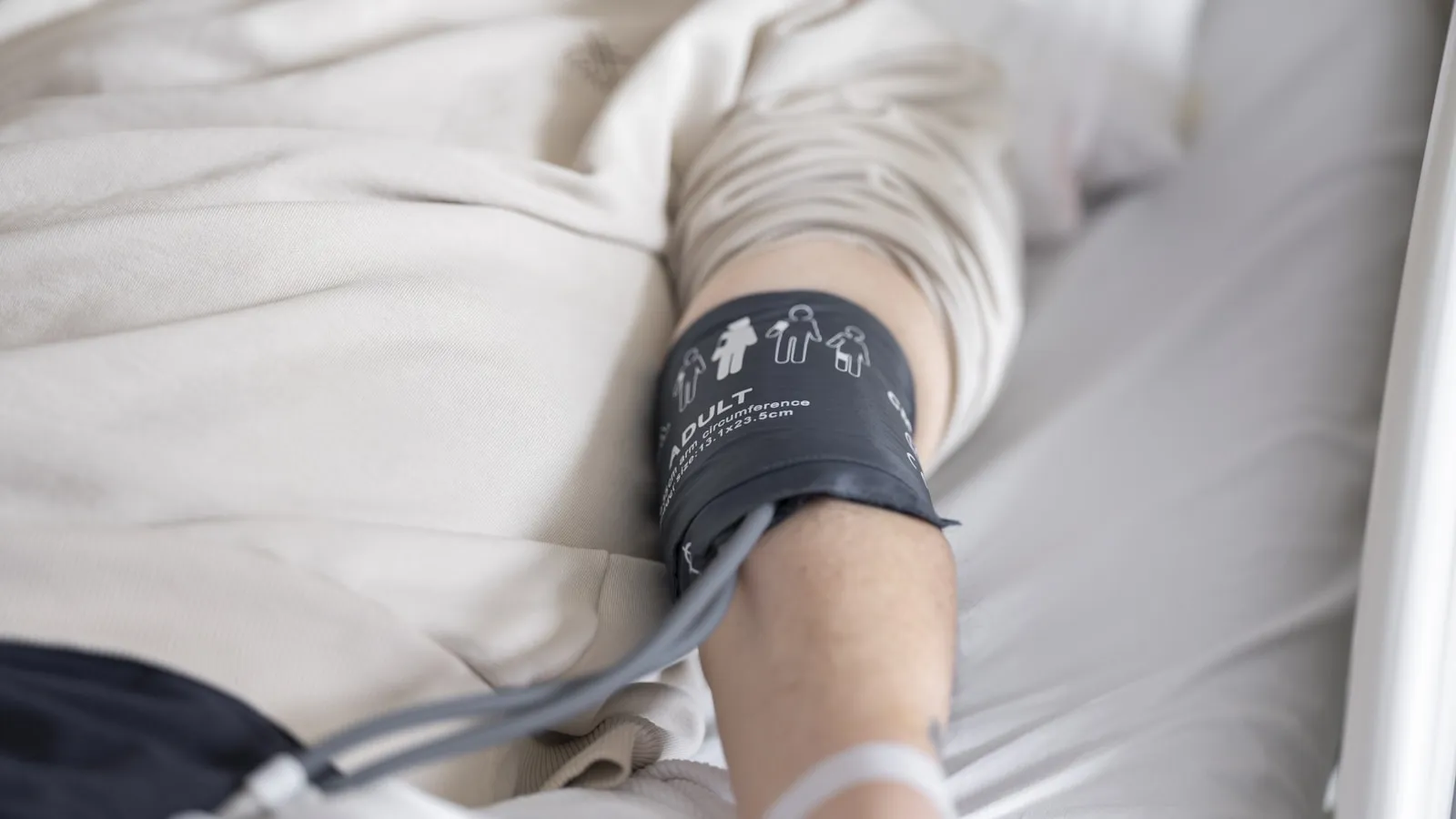
My neighbour sent me a photo of his blood pressure monitor: 148/92. He is 41, still plays football every Thursday, and felt absolutely nothing. That is exactly why high blood pressure in men goes unnoticed for years.
I then spent an afternoon reading the Dutch pages on this topic. Medically they are fine. Not one of them mentions that raised blood pressure is more common in men than in women up to around age fifty (NCD-RisC, 2021).
That feels like a missed opportunity. Plenty hangs off it: your kidneys, your blood sugar, your arteries and yes, your erection too.
Two other things are missing everywhere. Which blood values can sit alongside a raised blood pressure, and what a home reading of 148/92 actually says. Both are in a table below.
What is a normal blood pressure for a man?
Men use exactly the same cut-offs as women. Below 120/80 mmHg counts as optimal, and from 140/90 mmHg your GP will usually speak of hypertension. Measure at home and the line sits a little lower, around 135/85 mmHg, because home readings average out below surgery readings.
So there is no separate normal blood pressure for a man. There is a different trajectory. In men it tends to climb earlier, in women it climbs later and more steeply.
The top number is the systolic pressure. That is the pressure while your heart squeezes. The bottom number is the diastolic pressure, the pressure between two heartbeats.
Why a high diastolic number often shows up first in men
Under fifty, a raised diastolic reading is often the first thing you notice. Your systolic can still sit neatly below 140 while the bottom number creeps towards 95. It counts all the same.
The reason is arterial stiffness. In young, supple arteries the pressure between beats rises first. As the large arteries stiffen, the top number climbs hard and the bottom number sometimes drifts back down.
One single reading is never a conclusion.
What your home reading roughly means
Here is the first table. These are deliberately home values, so roughly 5 mmHg below what you would see at the surgery. If you land in two bands at once, say 128/96, the higher one counts.
| Home reading (mmHg) | What it is usually called | A sensible next step |
|---|---|---|
| Below 120/75 | Optimal | Nothing special. An occasional check is enough if you want to follow it. |
| 120/75 to 134/84 | Normal to slightly raised | Check again in a few months. Lifestyle carries the most weight in this band. |
| 135/85 to 149/94 | Grade 1, mildly raised | Measure morning and evening for a week. Take the average to your GP. |
| 150/95 to 174/104 | Grade 2, clearly raised | Booking a GP appointment is sensible, even if you feel fine. |
| From 175/105 | Strongly raised | Contact your GP within a short time frame. |
| From 180/110 with symptoms | Possibly urgent | With severe headache, chest pain, breathlessness or weakness on one side: call your GP, the out-of-hours service or the emergency number straight away. |
This grid is a reading aid, not a diagnosis. Your GP looks at far more than one number: your age, your weight, smoking, your family and what else shows in your blood.
Two men, both at 148/92
Man A is 34. He measured once, at his desk, after a double espresso, with the cuff over his jumper and his legs crossed. His 148/92 says something about that moment.
Man B is 52. He measured for a week, morning and evening, twice per session. He stayed between 145/90 and 155/95 the whole time.
Same number, a very different story. Man A has a measurement problem, man B has a pattern.
How you measure decides whether the number is worth anything. We worked that out in measuring blood pressure at home. If your reading only runs high at the doctor, read white coat hypertension.
High blood pressure in men: why it lands earlier
Up to somewhere around fifty, raised blood pressure is more common in men. After that it flips. In the largest analysis so far, covering 104 million people, worldwide prevalence sat at 34 percent in men and 32 percent in women (NCD-RisC, 2021).
Two percentage points sounds modest. Split by age group, the gap varies a lot. Below fifty it runs clearly against men, above fifty women catch up.
Why that happens is not fully settled. Part of it is lifestyle: men drink more alcohol on average, eat more salt and store fat around the middle sooner. Part of it probably sits in hormones and in how the kidneys hold on to sodium.
And part of it is practical. What strikes me: the first time many men have their blood pressure taken is when something else is already going on. A medical, an injury, a complaint that will not settle.
That is late.
What causes high blood pressure?
In about nine out of ten people there is no identifiable cause. That is called primary hypertension: a sum of heredity, age, weight, salt, alcohol, sleep and stress.
In the rest there is something concrete behind it, usually in the kidneys, the hormones or your breathing during sleep. That is secondary hypertension, and it can more often be tackled at the source.
Primary hypertension: the sum of small things
Salt is the best-known dial. In a Cochrane analysis of 34 trials, a modest salt reduction lowered systolic pressure in people with hypertension by 5.4 mmHg on average (He, 2013). In people with normal blood pressure the effect was smaller.
How much that buys you in your own kitchen depends on where you start. The numbers are broken down in salt and blood pressure.
Alcohol comes second. More than a couple of drinks a day can raise blood pressure measurably, and that effect often fades within weeks once you cut back.
Then there is fat around the middle, sitting still, smoking and poor sleep. Snoring with pauses in breathing belongs on the list too. Sleep apnoea is still missed in men, even though it can hold blood pressure up all night.
Stress belongs here as well, though not in the way most people assume. What cortisol does and does not do to your blood pressure sits in stress and blood pressure.
Secondary hypertension: when there is a cause
This group gets missed routinely, and that is the part I find hardest to accept. The best-known cause is too much aldosterone. That is the hormone telling your kidneys to hold on to sodium.
In a study of people newly diagnosed with hypertension in general practice, almost 6 percent had primary aldosteronism (Monticone, 2017). That is not rare. One of the clues can be a low potassium level in your blood.
Other possible causes include kidney disease, a narrowed renal artery, an over- or underactive thyroid and sleep apnoea. Medicines count too. Anti-inflammatories such as ibuprofen, some nasal sprays and a lot of liquorice can push your blood pressure up.
Liquorice is not a joke. Glycyrrhizin, the compound from liquorice root, can raise blood pressure noticeably in sensitive people.
Already on blood pressure medication and feeling tired, or noticing something about your erection? That is a familiar conversation at the GP. We wrote it out in side effects of blood pressure medication.
What symptoms come with high blood pressure?
Usually none at all. High blood pressure does not hurt and cannot be felt, not even when it is strongly raised. Some people notice a headache on waking, dizziness, a flushed face or ringing in the ears.
Those same symptoms turn up just as often with a normal blood pressure. So you cannot go by them.
That is why it is sometimes called the silent condition. I find the phrase badly chosen, because it sounds more sinister than it is. All it means is that measuring is the only way to know.
Some signals do deserve faster attention. Sudden severe headache, blurred vision, chest pain, breathlessness or confusion do not belong with ordinary raised blood pressure. Contact a doctor straight away if they appear.
And there is one complaint that gets men into the surgery faster than any number. I come back to that below.
Which blood tests go with high blood pressure?
Blood work does not measure your blood pressure. It looks at what sits around it: your kidneys, your salt balance, your blood sugar, your lipids and your thyroid. A doctor can use those values to look for a possible cause and for what else is happening in your arteries.
So it does not replace measuring. It puts a layer underneath it.
This is the table I could not find anywhere else. Per value it says what it looks at and why it can matter when blood pressure is high.
| Blood value | What it looks at | Why it can matter when blood pressure is high |
|---|---|---|
| Potassium | Your salt balance and indirectly the hormone aldosterone | A low potassium can fit with too much aldosterone, a cause found more often than assumed (Monticone, 2017) |
| Sodium | Your fluid and salt balance | Can shift with kidney or hormonal causes, and with diuretic use |
| Creatinine and eGFR | How well your kidneys filter | Kidneys can be both a cause and a consequence of raised blood pressure |
| Glucose and HbA1c | Your blood sugar now and over recent weeks | Raised blood sugar and raised blood pressure often turn up together |
| Cholesterol and LDL | The fats in your blood | Feeds into the estimate of your overall vascular risk, alongside your blood pressure |
| TSH | The signal driving your thyroid | Both an underactive and an overactive thyroid can affect blood pressure |
Important: this is not a checklist and not a protocol. Which values a doctor looks at depends on your story, your age, your medication and what the readings show.
Potassium is the most useful number almost nobody mentions. It costs nothing extra, it sits in nearly every basic panel, and it is one of the few pointers towards a cause you can genuinely address.
If you want those values drawn in one go, most of them sit in our cardiovascular health blood test. Whatever comes out, discuss it with your GP.
Does high blood pressure affect your erection?
Often, yes. An erection is first of all a matter of blood flow. The arteries in your penis are narrower than your coronary arteries, so when the lining of your vessels stiffens, it shows there sooner. Erection problems can therefore be an early signal.
The numbers fit that picture. In the Massachusetts Male Aging Study, complete erectile dysfunction affected roughly 15 percent of men treated for high blood pressure, against 9.6 percent across the whole sample (Feldman, 1994).
In a meta-analysis of cohort studies, erectile dysfunction was associated with a higher risk of cardiovascular events and death from any cause (Vlachopoulos, 2013). Association is not causation. Most men with erection problems do not have a heart problem.
What matters here: it runs both ways. Erection problems can say something about your arteries, and some blood pressure medicines can cause erection problems themselves.
Stopping your medication on your own is a poor plan. Put it to your GP instead, because there are usually alternatives.
And no, there is no shame attached. For a lot of men this is the subject that finally gets them into the waiting room, and that is fine.
Can you grow old with high blood pressure?
Yes, and plenty of people do. High blood pressure is not a diagnosis that fixes your life expectancy, it is a risk factor that weighs in.
How high it sits and how long it sits there both count. It is also one of the risk factors you can most readily shift.
The relationship itself is well described. In an analysis of data from one million adults, each 20 mmHg higher systolic pressure above 115/75 was associated with roughly a doubling of vascular mortality (Lewington, 2002).
That sounds harsh. Read it the other way round: every step down counts just as much.
In the SPRINT trial, people at raised risk were given tighter blood pressure treatment. That group had fewer cardiovascular events than the group on the usual target (Wright, 2015).
That was a trial in a selected group, not advice for everyone. What suits you is something you settle with your GP.
If you want to read it back in plain language, Thuisarts and the Hartstichting do that well.
What you can do now
My advice is boring and it works. Measure for a week, morning and evening, two readings each time with a minute in between. Write everything down, including the outliers you would rather forget.
Take that weekly average to your GP, not the one number that startled you.
If you want to know what else is showing in your blood, take a look at our men's health blood panel. It covers your kidney function, your blood sugar, your lipids and your thyroid, among others. Those numbers say nothing about your blood pressure itself, but plenty about the terrain around it.
Every blood test result includes a professional assessment from a BIG-registered doctor. For treatment decisions, discuss your results with your GP.
References
- NCD Risk Factor Collaboration (NCD-RisC). Worldwide trends in hypertension prevalence and progress in treatment and control from 1990 to 2019: a pooled analysis of 1201 population-representative studies with 104 million participants. Lancet. 2021. PMID 34450083.
- He FJ, Li J, MacGregor GA. Effect of longer term modest salt reduction on blood pressure: Cochrane systematic review and meta-analysis of randomised trials. BMJ. 2013. PMID 23558162.
- Monticone S, Burrello J, Tizzani D, et al. Prevalence and clinical manifestations of primary aldosteronism encountered in primary care practice. J Am Coll Cardiol. 2017. PMID 28385310.
- Feldman HA, Goldstein I, Hatzichristou DG, et al. Impotence and its medical and psychosocial correlates: results of the Massachusetts Male Aging Study. J Urol. 1994. PMID 8254833.
- Vlachopoulos CV, Terentes-Printzios DG, Ioakeimidis NK, et al. Prediction of cardiovascular events and all-cause mortality with erectile dysfunction: a systematic review and meta-analysis of cohort studies. Circ Cardiovasc Qual Outcomes. 2013. PMID 23300267.
- Lewington S, Clarke R, Qizilbash N, et al. Age-specific relevance of usual blood pressure to vascular mortality: a meta-analysis of individual data for one million adults in 61 prospective studies. Lancet. 2002. PMID 12493255.
- Wright JT Jr, Williamson JD, Whelton PK, et al. A randomized trial of intensive versus standard blood-pressure control. N Engl J Med. 2015. PMID 26551272.
Autor
Caliberhealth
Powiązane badania
Powiązane artykuły

Stress and blood pressure: what cortisol does and does not do

White coat hypertension: why your blood pressure is higher at the doctor