Measuring blood pressure at home looks simple: cuff on, press the button, write the number down. Yet Monday says 148/92 and Wednesday says 128/81. Which one is right?
Probably neither. A home reading only becomes useful once the conditions around it are right. That is where most men slip, and it is rarely a broken monitor.
I think most instruction sheets are too polite about this. They tell you neatly what to do. They rarely tell you how many mmHg it costs when you don't.
It costs a surprising amount.
Why measuring blood pressure at home goes wrong so often
Your monitor is almost never the problem. An arm hanging at your side, talking during the reading, a full bladder: each of those pushes your number up. Coffee in the last half hour and a cuff that doesn't fit do the same. Together they can shift you ten to twenty mmHg.
That is how a nonsense reading is born.
These six things pollute a reading hardest.
- Not sitting still for five minutes first. You are still measuring the stairs or your ride home.
- Slouching, legs crossed, feet off the floor.
- Talking or scrolling during the reading, or half-watching the television.
- A full bladder, which can noticeably lift your systolic number.
- The cuff over a rolled-up sleeve, which then squeezes your arm above it.
- Coffee, a cigarette or a workout in the half hour before.
That rolled-up sleeve is the quiet killer on this list. You see nothing of it on the display.
The Dutch heart foundation Hartstichting describes the same basics: sit quietly, support the arm, keep the cuff at heart level. It sounds dull. It is the difference between measuring and guessing.
Which cuff fits your upper arm?
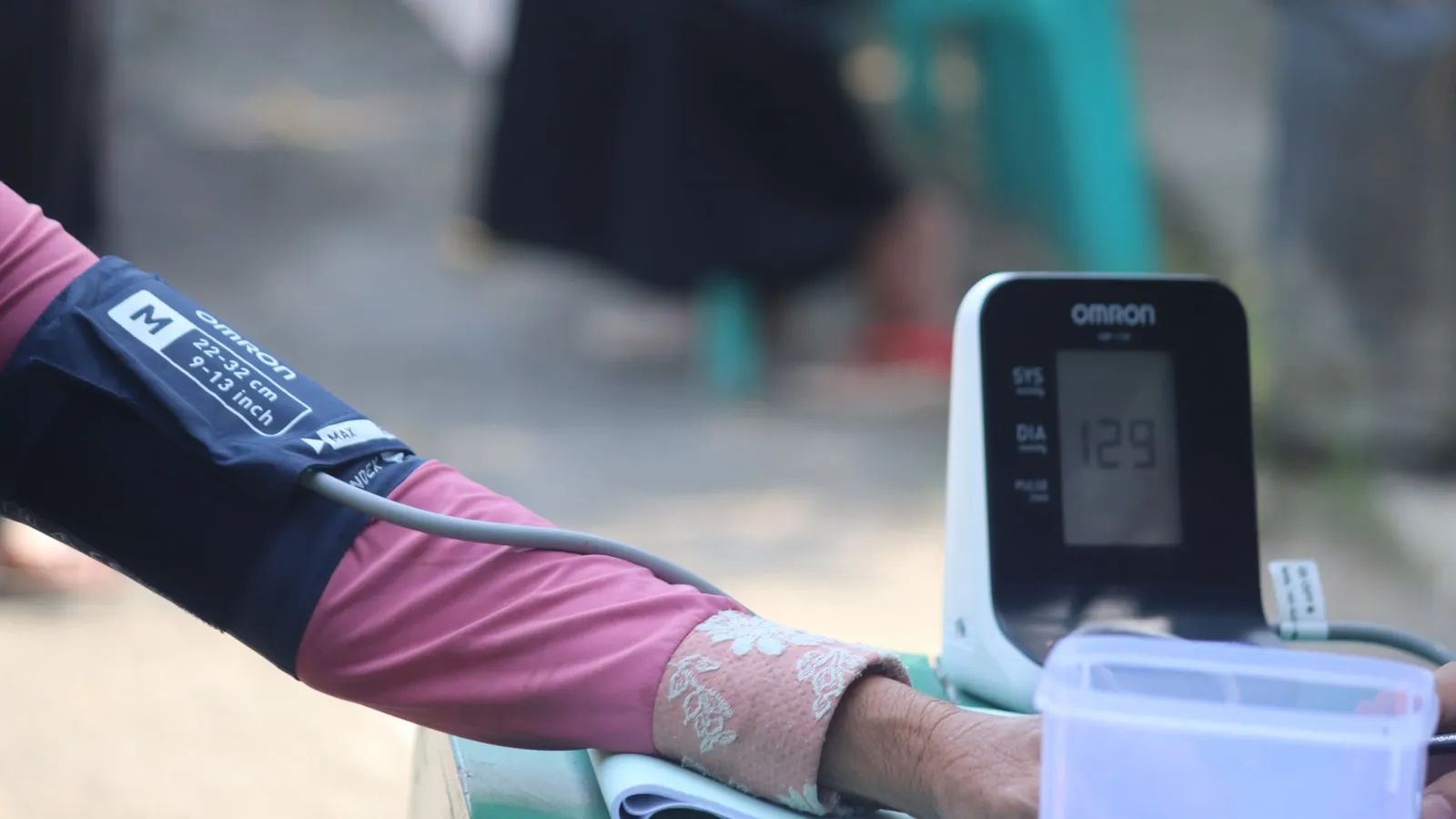
That depends on your arm circumference, not on your height or your weight. Take a tape measure and wrap it around the thickest point of your upper arm, arm relaxed at your side. If that number falls outside the range printed on your cuff, your reading is skewed. Too small squeezes too hard and reads high.
Every cuff has a range in centimetres printed on it. That range is the only size that matters, because the letters differ per brand.
| Arm circumference | Cuff size | What the box usually says |
|---|---|---|
| 17 to 22 cm | small | S, small adult, range 17-22 cm |
| 22 to 32 cm | standard | M, medium, range 22-32 cm (the one in the box) |
| 32 to 42 cm | large | L, large, range 32-42 cm (ordered separately) |
| 42 to 50 cm | extra large | XL, range 42-50 cm |
What strikes me about men who train: almost none of them has ever measured his upper arm. That is exactly where the error sits.
Picture a 34-year-old with a 38 cm upper arm. He measures at home with the standard cuff from the box and sees 148/92. His GP, using a large cuff, gets 133/84. Same man, same morning, two completely different conversations.
In a randomised trial of 195 adults, that went badly wrong. People who needed an extra-large cuff read 19.5 mmHg too high on the standard one (Ishigami, 2023, PMID 37548984). For those needing a large cuff it was 4.8 mmHg too high. And for those who needed a small cuff, the standard one read 3.6 mmHg too low.
So the error points the wrong way. A heavy or muscular upper arm reads high, not low.
Measure your arm first, then your blood pressure.
How should you hold your arm while measuring?
Supported on a table, with the middle of the cuff at heart level. Your arm should not hang in the air or rest limply on your lap. Sit upright with your back against the chair and your feet flat on the floor. Rest your forearm on the surface so your muscles do nothing.
The difference is bigger than it sounds. In a randomised trial of 133 adults, an arm resting on the lap gave a systolic reading 3.9 mmHg higher than a supported arm on a desk. An arm hanging at the side ran 6.5 mmHg higher (Liu, 2024, PMID 39373998).
Six mmHg is the gap between 134 and 140.
If your kitchen table sits too high or too low, put a book or a folded towel under your elbow. What matters is the height of the cuff, not the table.
How many readings in a row are you allowed to take?
Two readings back to back, with roughly a minute of rest between them, is the usual approach. The first often runs higher, because your body is still reacting to the squeeze of the cuff. Take a third because the first two displeased you, and you are shopping among your own numbers.
Dutch GP practices often ask for a seven-day series. Two sessions a day, morning and evening, two readings each time, with day one left out of the assessment. We don't prescribe a measuring frequency. Ask your GP which schedule they want to see.
Write everything in a blood pressure diary, including the readings you would rather not have seen. An app or your monitor's memory works just as well. The average across the whole series is what counts, not your prettiest morning.
A single isolated reading says almost nothing.
When is a home reading too high?
A lower threshold applies at home than at the practice. For an averaged home reading it sits around 135/85 mmHg, for a practice reading around 140/90 mmHg. That gap isn't sloppiness. At home you measure in your own surroundings, without the tension of the consulting room, so the same risk sits at a lower number.
| Type of reading | Threshold commonly used | Why the threshold differs |
|---|---|---|
| Home reading, averaged over several days | around 135/85 mmHg | Calm surroundings and no white coats, so lower numbers carry the same risk. |
| Practice reading at your GP | around 140/90 mmHg | The tension of the consulting room is already baked into this number. |
| 24-hour reading, averaged across the full day | around 130/80 mmHg | The night is included, and blood pressure runs lower overnight. |
This is where I watch readers go wrong again and again. You measure 137/86 at home, hold it against the 140/90 you picked up somewhere, and conclude you are fine. Against the home threshold you are just over it.
Researchers followed 6,470 people across five countries for a median of 8.3 years. The home thresholds that best matched cardiovascular risk sat lower than the usual practice thresholds (Niiranen, 2013, PMID 23129700). Home readings also kept predictive value after adjusting for the practice reading (Ward, 2012, PMID 22241136).
One high reading is not a diagnosis, and this article isn't one either. A raised average across a full week is worth discussing with your GP. If home and practice diverge sharply, read white coat hypertension, because that gap runs both ways.
Can a smartwatch measure your blood pressure?
Right now, not reliably enough to steer by. Most watches and rings estimate blood pressure from a wrist signal, without a cuff. There is no generally accepted way to validate those estimates. The European working group on blood pressure monitoring calls the questions about their accuracy unanswered (Stergiou, 2022, PMID 35708294).
There is a second catch. Many of those devices need periodic calibration against an ordinary cuff monitor.
So you are really looking at your old cuff reading with a trend line drawn over it. As a trend, that is fine. As a number your GP can work with, not yet.
My advice stays boring: a validated upper-arm monitor with the right cuff. Wrist monitors are more sensitive to posture errors, because your wrist rarely sits at heart level by itself. Thuisarts, the Dutch GP-authored patient site, also describes the upper-arm monitor as the usual choice at home.
What your blood does and doesn't say here
Blood pressure itself is measured with a cuff, never in your blood. Even so, a few things that hang together with blood pressure are visible in blood work. Those you miss with only a monitor on your bedside table.
- Creatinine and eGFR: your kidneys and your blood pressure influence each other both ways.
- Sodium and potassium: an off balance can accompany high blood pressure. See salt and blood pressure.
- Glucose and HbA1c: disordered blood sugar often runs alongside high blood pressure.
- TSH: a disordered thyroid can affect your blood pressure and your heart rate.
- Cholesterol: says nothing about your blood pressure, but counts in the same risk picture.
The cardiovascular health test brings several of these values into view in a single draw. It doesn't replace your monitor and it isn't a diagnosis. It can give context to what you see at home.
What to do next
Take a tape measure and measure your upper arm. It costs you twenty seconds and it is the one step here that can genuinely move your reading. If you read 38 cm while your cuff says 22-32 cm, order a large cuff first.
Then measure for a week using the schedule your GP wants to see, write it all down, and take the average to your appointment. I would put your latest blood results next to it.
If you want to read on: high blood pressure in men is the overview this piece sits under. Stress and blood pressure covers what cortisol does and doesn't do, and blood pressure medication side effects matters once you are on medication.
References
- Ishigami J, Charleston J, Miller ER 3rd, Matsushita K, Appel LJ, Brady TM. Effects of cuff size on the accuracy of blood pressure readings: the Cuff(SZ) randomized crossover trial. JAMA Intern Med. 2023;183(10):1061-1068. PMID 37548984.
- Liu H, Zhao D, Sabit A, et al. Arm position and blood pressure readings: the ARMS crossover randomized clinical trial. JAMA Intern Med. 2024;184(12):1436-1442. PMID 39373998.
- Niiranen TJ, Asayama K, Thijs L, et al. Outcome-driven thresholds for home blood pressure measurement: international database of home blood pressure in relation to cardiovascular outcome. Hypertension. 2013;61(1):27-34. PMID 23129700.
- Ward AM, Takahashi O, Stevens R, Heneghan C. Home measurement of blood pressure and cardiovascular disease: systematic review and meta-analysis of prospective studies. J Hypertens. 2012;30(3):449-456. PMID 22241136.
- Stergiou GS, Mukkamala R, Avolio A, et al. Cuffless blood pressure measuring devices: review and statement by the European Society of Hypertension Working Group on Blood Pressure Monitoring and Cardiovascular Variability. J Hypertens. 2022;40(8):1449-1460. PMID 35708294.
- Hartstichting. Bloeddruk (Dutch heart foundation). 2025. hartstichting.nl
- Thuisarts.nl. Hoge bloeddruk (Dutch GP-authored patient information). 2025. thuisarts.nl
Every blood test result includes a professional assessment from a BIG-registered doctor. For treatment decisions, discuss your results with your GP.
الكاتب
Caliberhealth
فحوصات ذات صلة
مقالات ذات صلة

Stress and blood pressure: what cortisol does and does not do

White coat hypertension: why your blood pressure is higher at the doctor