Order a Graves test and check thyroid antibodies
TSH, Free T4, Free T3, and TSH Receptor Antibodies to help assess Graves' disease.
Add to Cart
No referral needed
Added to your cart
Click the button to view your cart
Biomarkers Included
4 biomarkersTSH (Thyroid Stimulating Hormone), TSH Receptor Antibodies, Free T4 (Thyroxine), Free T3 (Triiodothyronine)
Graves' disease is an autoimmune condition in which your thyroid can produce too many hormones. Symptoms like a racing heart, weight loss or restlessness can sometimes come with it.
This Graves' test combines TSH, free T4, free T3 and thyroid antibodies (TSH receptor antibodies) in a single blood draw at a certified sample point. You order online, need no referral and receive your results within a few working days, with a doctor's assessment.
Why this test?
Standard thyroid panels measure TSH and the thyroid hormones, but with a possibly overactive thyroid you often want to go a step further. A Graves' test adds thyroid antibodies, which may help distinguish Graves' disease from other causes of an overactive thyroid.
That makes this more than a plain hyperthyroidism test: the combination of hormones and antibodies gives extra context in one go.
Who is this test for?
This test may be relevant for men who:
- have been told their thyroid values are elevated and want more insight
- have symptoms that fit an overactive thyroid, such as unexplained weight loss, restlessness, tremors or heat sensitivity
- want thyroid antibodies measured alongside the standard thyroid markers
What is tested?
- TSH (thyroid-stimulating hormone) (mu/l, ref: 0.27-4.2): the hormone your pituitary uses to regulate thyroid activity.
- Free T4 (thyroxine) (pmol/l, ref: 12-22): the unbound, active form of thyroxine.
- Free T3 (triiodothyronine) (pmol/l, ref: 3.1-6.8): the unbound, active form of T3, the more potent thyroid hormone.
- TSH receptor antibodies (TRAb) (kU/l): thyroid antibodies that may stimulate the TSH receptor, potentially causing the thyroid to overproduce hormones.
What can this test tell you?
The combination of a suppressed TSH with elevated free T4 or free T3 may suggest an overactive thyroid. If thyroid antibodies are also present, this pattern could point toward Graves' disease as the underlying cause.
Several conditions can produce a similar pattern, though, so this result is not a diagnosis. A doctor can interpret the results together with your symptoms. If you first want only the basic function of your thyroid in view, look at the thyroid function test.
How is the sample collected?
Blood is drawn at a certified sample point. There are 700+ locations across the Netherlands, which you choose yourself after ordering. The appointment usually takes 10 to 15 minutes.
You arrange this without your GP: no referral, just choose a location and time that suit you.
When is this test useful?
This Graves' test can be useful with symptoms that could be associated with an overactive thyroid, such as unexplained weight loss, an increased heart rate, tremors or anxious feelings. It can also fit if you previously had abnormal thyroid values and want a more targeted follow-up.
Because it is a blood test without a referral, you decide yourself when to start.
What do the results mean?
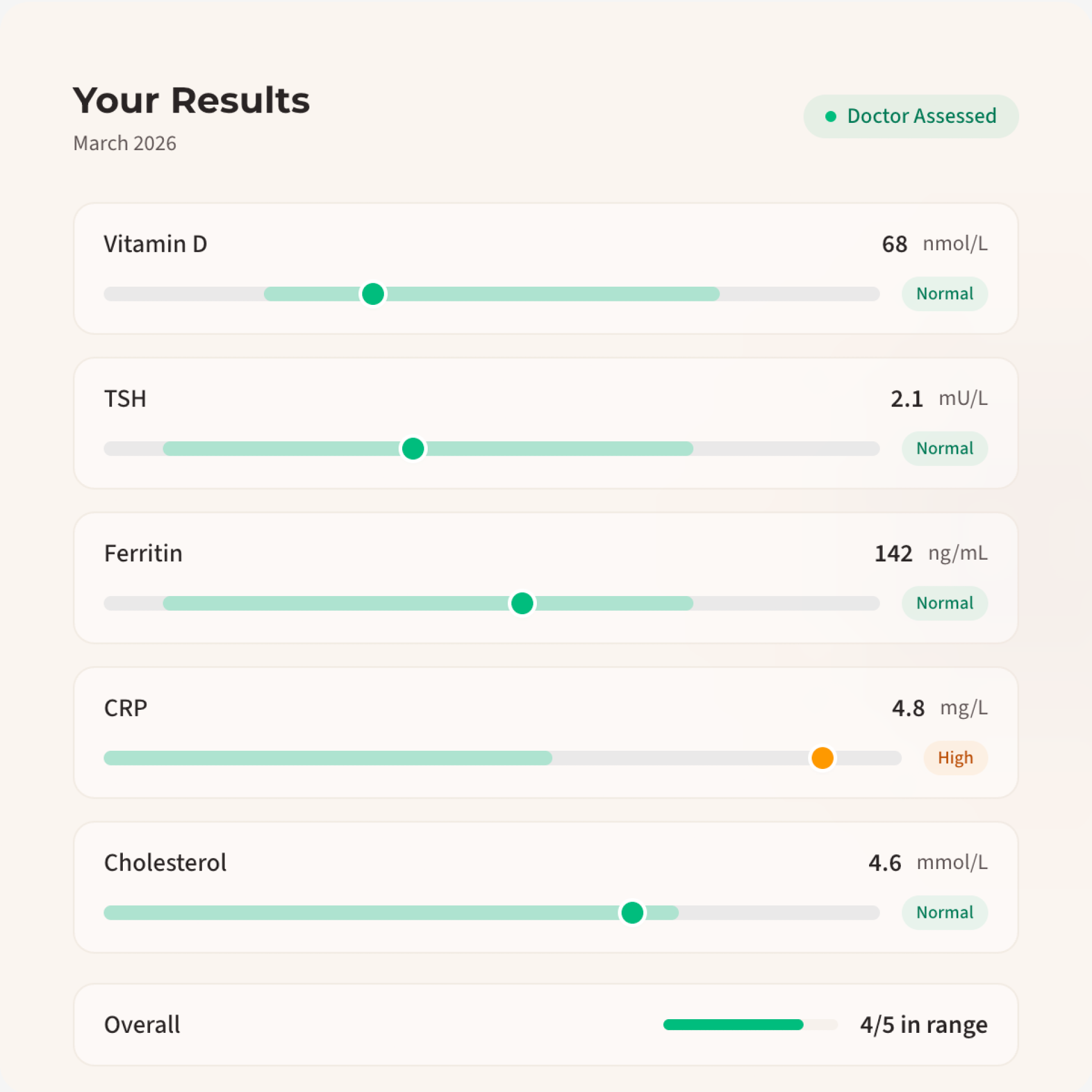
Your result shows each marker alongside a reference range. The presence or absence of thyroid antibodies, together with your hormone values, can provide additional context.
Individual values say little on their own. A doctor can help determine what the overall pattern may indicate and whether further evaluation is worthwhile.
What happens after the results?
Your results are available within a few working days in your personal dashboard, clearly presented with reference ranges. Because Graves' disease calls for professional assessment, it is wise to discuss your result with a doctor, especially if antibodies are found or values fall outside the reference range.
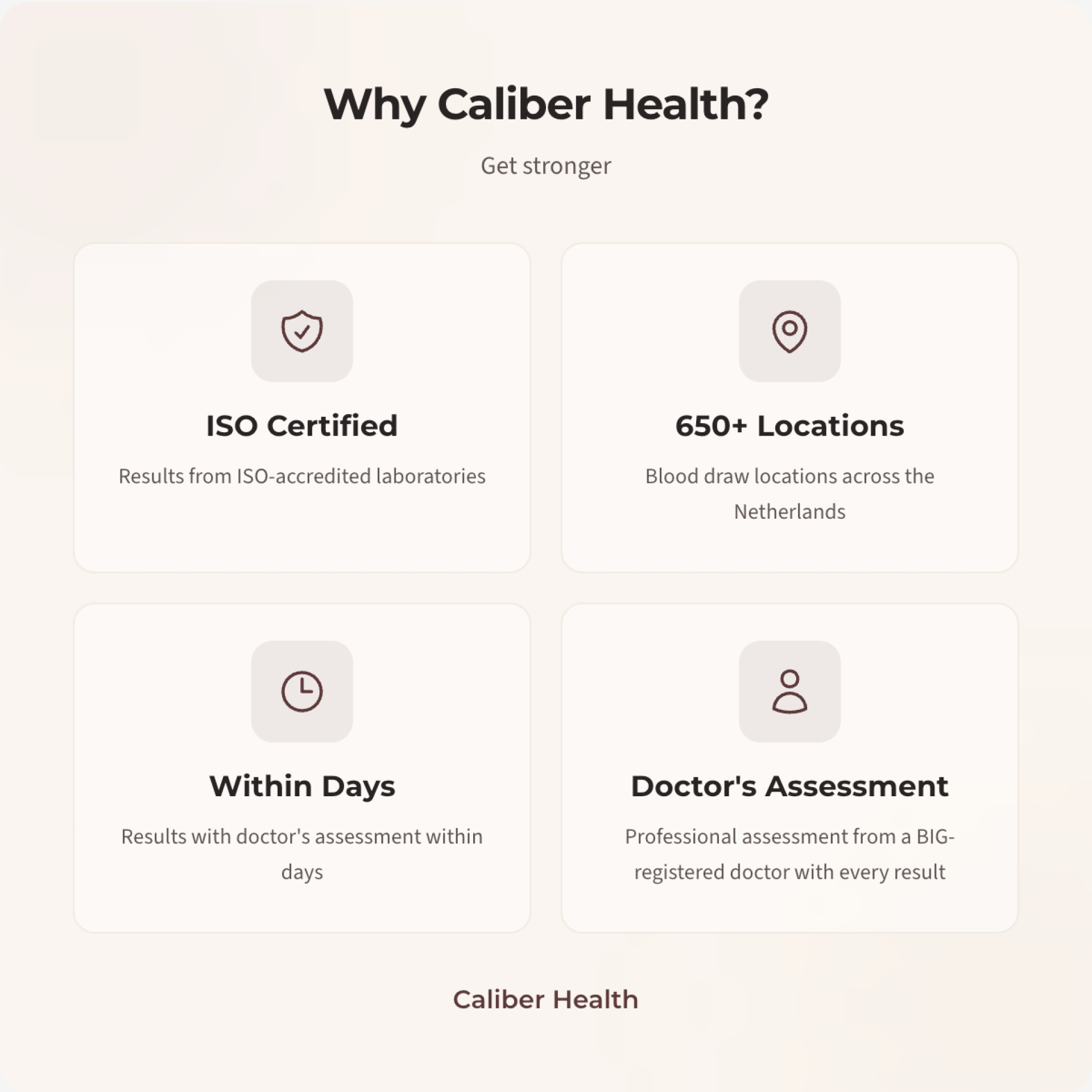
Every blood test result includes a professional assessment from a BIG-registered doctor. For treatment decisions, discuss your results with your GP.
Frequently Asked Questions
A regular thyroid test measures TSH, free T4 and free T3. A Graves' test adds thyroid antibodies (TSH receptor antibodies), which may help distinguish Graves' disease from other causes of an overactive thyroid.
TRAb stands for TSH receptor antibodies. These are thyroid antibodies that may stimulate the TSH receptor, potentially causing the thyroid to overproduce hormones.
No. You order the test online, choose a sample point yourself and need no referral from your GP. Always discuss your result with a doctor.
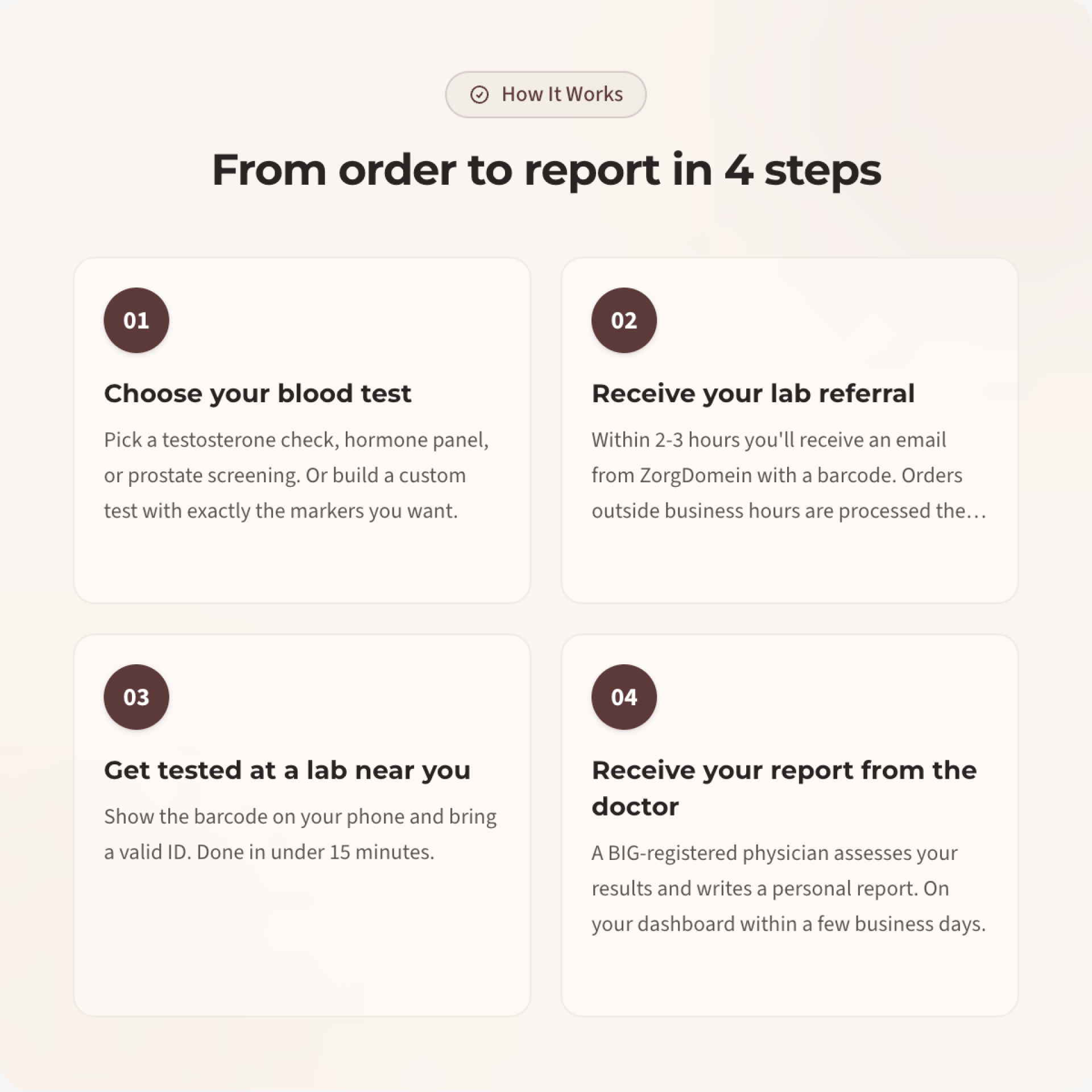
From order to report in 4 steps
No referral needed. No waiting list. Just order and go.
Choose your blood test
Pick a testosterone check, hormone panel, or prostate screening. Or build a custom test with exactly the markers you want.
Receive your lab referral
Within 1 business day you'll receive an email from ZorgDomein with a barcode. Orders outside business hours are processed from the next business day.
Get tested at a lab near you
Show the barcode on your phone and bring a valid ID. Done in under 15 minutes.
Receive your report from the doctor
A BIG-registered physician assesses your results and writes a personal report. On your dashboard within a few business days.
Choose your blood test
Pick a testosterone check, hormone panel, or prostate screening. Or build a custom test with exactly the markers you want.
Receive your lab referral
Within 1 business day you'll receive an email from ZorgDomein with a barcode. Orders outside business hours are processed from the next business day.
Get tested at a lab near you
Show the barcode on your phone and bring a valid ID. Done in under 15 minutes.
Receive your report from the doctor
A BIG-registered physician assesses your results and writes a personal report. On your dashboard within a few business days.
Always a location near you
With 700+ certified phlebotomy points across the Netherlands.
What We Test
This panel includes 4 biomarkers, each tested at a certified laboratory using medical-grade equipment.
| No. | Biomarker | Unit | Turnaround |
|---|---|---|---|
| 01 | TSH (Thyroid Stimulating Hormone) TSH is thyroid-stimulating hormone. The pituitary gland makes it, and uses it to drive your thyroid. At the laboratory that runs the test the usual adult range runs from 0.27 to 4.20 mE/L. A high TSH usually fits an underactive thyroid. A low value usually fits an overactive one. That direction feels inverted, and it is. TSH is the pituitary signal, not the thyroid hormone itself. Laboratories use slightly different limits from one another. Always read the reference value printed on your own result. And a single measurement is never a diagnosis. | mu/l | 2 days |
| 02 | TSH Receptor Antibodies TSH receptor antibodies (TRAb) target the TSH receptor on thyroid cells. These antibodies are primarily associated with Graves' disease and may either stimulate or block thyroid function. Your healthcare provider can help interpret what your TRAb results mean for your thyroid health. | kU/l | 3 days |
| 03 | Free T4 (Thyroxine) Free T4 (thyroxine) is the main hormone produced by the thyroid gland. It may serve as a precursor that your body converts into the more active T3. Healthcare providers often consider Free T4 a primary indicator of thyroid gland output. | pmol/l | 4 days |
| 04 | Free T3 (Triiodothyronine) Free T3 (triiodothronine) is considered the most active thyroid hormone. It may play a key role in regulating metabolism, energy production, and body temperature. Healthcare providers often assess Free T3 alongside other thyroid markers for a comprehensive picture. | pmol/l | 4 days |
| Your result arrives once the slowest test is finished: 4 days. This is indicative; turnaround varies per laboratory. | |||
Preparation
-
Pause biotin
RequiredDo you take a supplement with biotin (vitamin B8, common in hair, skin and nail supplements)? Stop it 72 hours before the draw. Biotin interferes with the measurement of these values.
-
Timing worth knowing
Good to knowIf you repeat this test, pick the same time of day each time so the results compare.
-
On levothyroxine? Worth knowing
Good to knowTell the staff at the draw when you took your tablet; for most values the timing makes no difference.
- Water is always fine. Drink as usual beforehand, it makes the draw easier.
- Take your usual medication, unless your own doctor told you otherwise.
Extend this panel
Tests from the same field, run on the same sample. Same draw, no second appointment.
Related Tests
Explore more tests that might interest you.
Cortisol Test
We advise against this test for stress, burnout or fatigue. Order it only if your doctor asked for it.
PSA Test
Measure your PSA, a marker for the health of your prostate. No referral needed, results within a few working days.
DHEA-S Test
Measure your DHEA-S, an adrenal building block for your sex hormones. No referral needed.
This test not quite right?
Build your own blood test from 139+ individual biomarkers — choose exactly what you need.
Have a question?
Our team is happy to help. Ask your question and we'll respond as soon as possible.