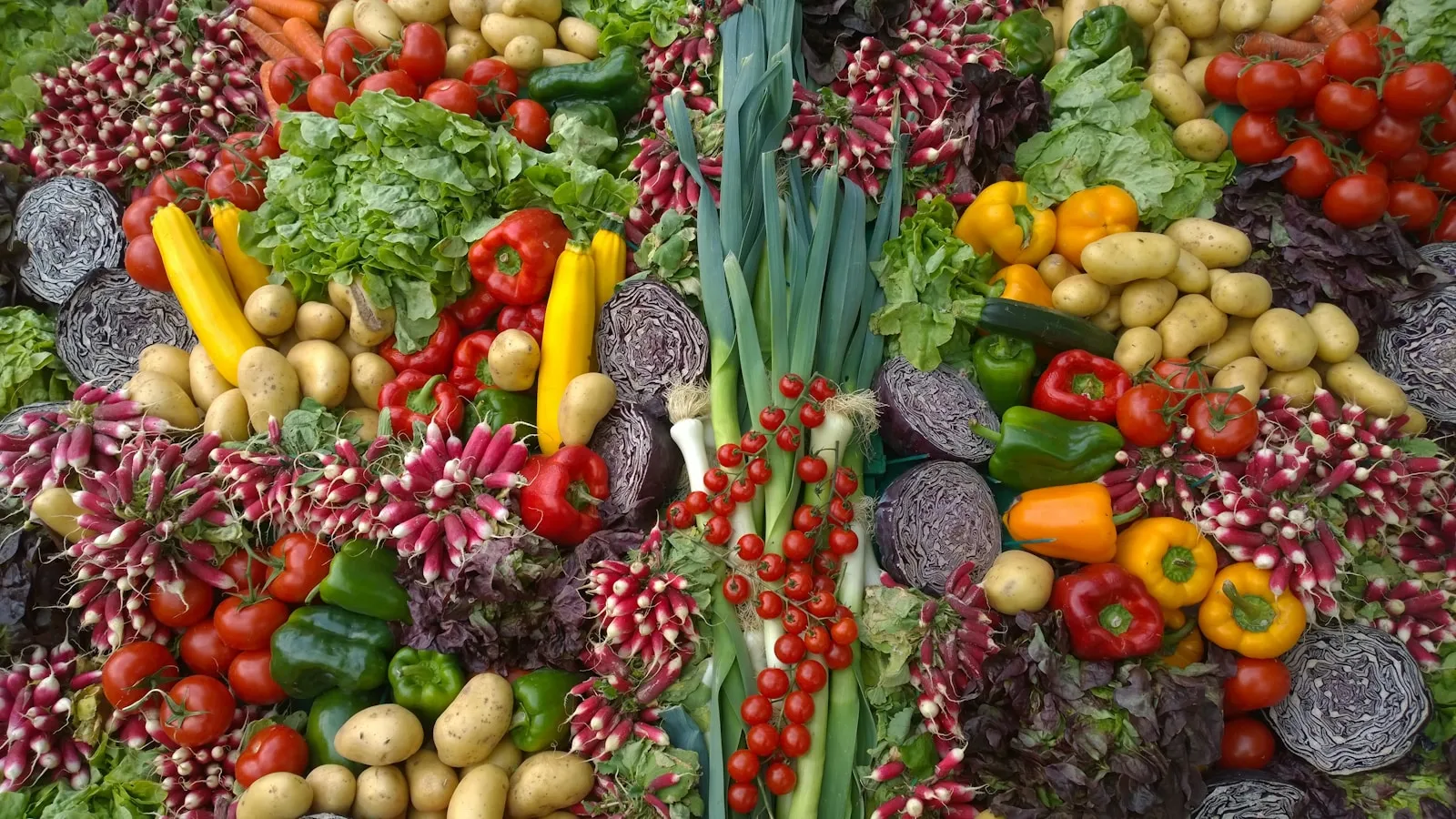
Which fruit should you avoid with gout? Honest answer: less than you think. You do not need to cut whole fruit. The types worth limiting are the high-fructose ones, such as grapes, mango, pear and apple, and above all fruit juice. Two pieces of whole fruit a day fits fine with gout.
More important than the list is the reason. With fruit the purine logic does not apply, and that is exactly where most advice goes wrong.
Why fruit works differently from a steak
With gout you think of purines: red meat, organ meat, prawns, beer. Your body converts those into uric acid. Fruit, however, contains barely any purines, so little happens along that route. Fruit works through a second mechanism: fructose.
Fructose is broken down rapidly in your liver cells, and that process burns through a lot of ATP, your energy molecule, all at once. Uric acid is released during that breakdown. More fructose therefore means more uric acid production, without a single purine involved.
That difference has been shown cleanly. In a cohort of more than 47,000 men, purine-rich vegetables carried no added gout risk at all, while meat and seafood did (Choi et al., 2004. PMID 15014182). Plant purines simply behave differently.
Which fruit is worth limiting with gout?
It comes down to the amount of fructose per portion, not to whether it is fruit. Below is a ranking based on fructose content. Treat it as an order of attention, not a banned list.
| Fruit | Fructose (approx. per 100 g) | Attention |
|---|---|---|
| Grapes | around 8 g | Limit, portions add up fast |
| Apple | around 6 g | Limit to one a day |
| Pear | around 6 g | Limit to one a day |
| Mango | around 5 g | Small portion |
| Banana | around 5 g | Fine in normal amounts |
| Kiwi | around 4 g | Fine |
| Blueberries | around 4 g | Fine |
| Orange | around 3 g | Fine as whole fruit, not as juice |
| Strawberries | around 2 g | Fine |
| Cherries | around 6 g | Favourable despite the fructose, see below |
Dried fruit sits outside this table, and not in your favour. Raisins, dates and dried figs are concentrated fruit: the same sugar content in a fraction of the volume. A handful of raisins delivers the fructose of a decent bunch of grapes.
Which fruit actually helps with gout?
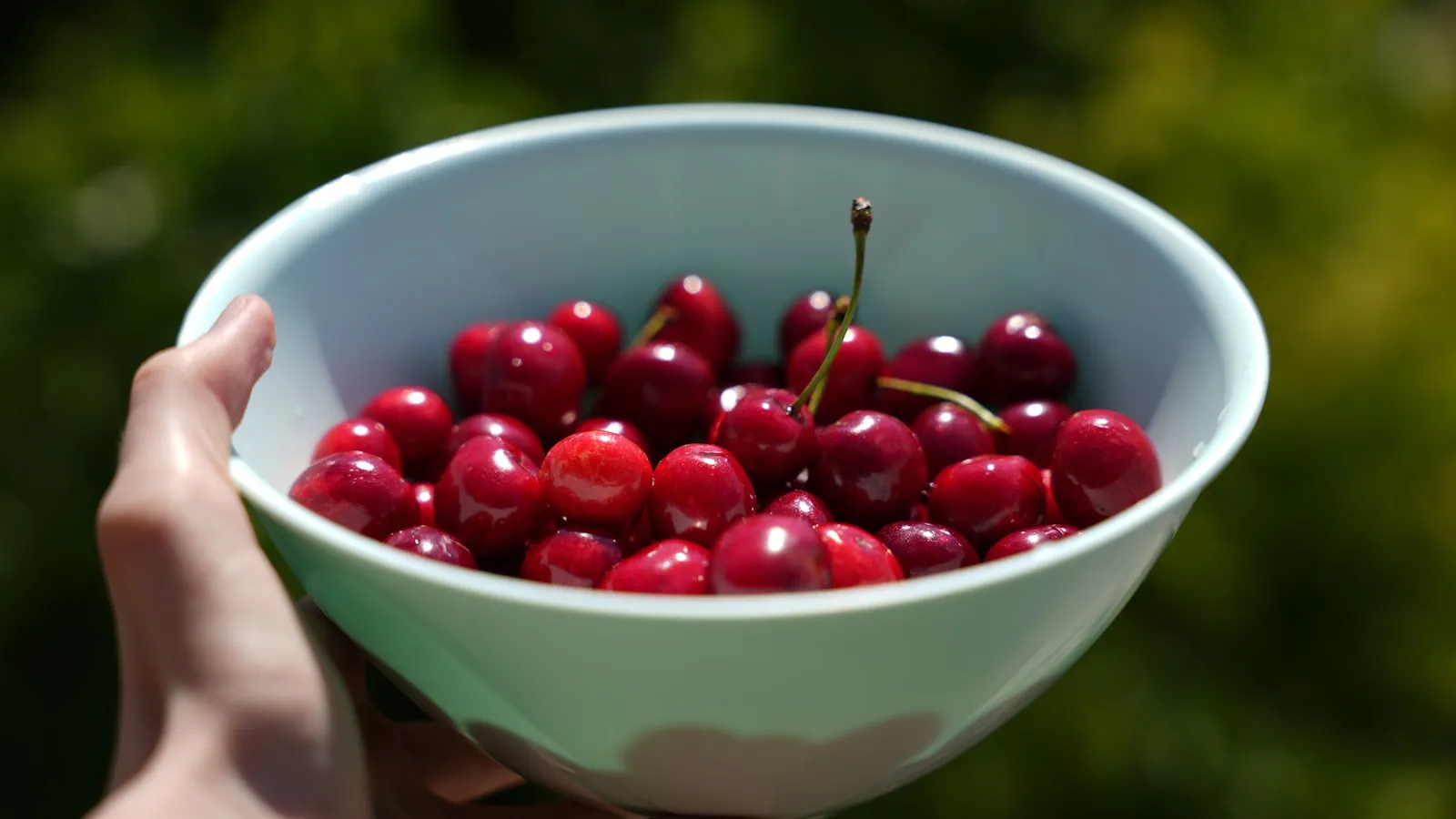
Cherries are the striking exception. Despite a fructose content comparable to apple, they appear to lower the number of gout attacks rather than raise it. That is attributed to anthocyanins, the red pigments with an anti-inflammatory action.
In a study among people with gout, cherry intake over a two-day period was associated with a 35 percent lower risk of an attack. Combined with allopurinol that rose to roughly 75 percent (Zhang et al., 2012. PMID 23023818).
I will say straight away that this is observational research, not proof that cherries treat gout. But if you are choosing fruit anyway, this is a sensible pick.
Fruit juice is the real problem
If you change one thing, make it this. Juice delivers the fructose of four oranges without the fibre, and you drink it in thirty seconds. Whole fruit fills you up, juice does not.
The numbers are solid. In a prospective study of 46,393 men followed over twelve years, men drinking two or more sugar-sweetened soft drinks a day had an 85 percent higher gout risk. At the highest fructose intake the risk had more than doubled. Diet soft drinks showed no raised risk, which shows it really is the sugar (Choi et al., 2008. PMID 18244959).
Take two men who both say they eat healthily, an orange against a glass of juice: in fructose there is a factor of 3 to 4 between them. On paper both are eating fruit. In your liver something quite different happens.
So how much fruit per day?
Two pieces of unprocessed fruit a day is a common starting point, in line with what the Dutch nutrition centre Voedingscentrum advises for everyone. With gout there is little reason to be stricter, as long as you stick to whole fruit.
Where it goes wrong is stacking: a smoothie at breakfast, juice at lunch, dried fruit as a snack and a bunch of grapes in front of the television. Each part looks healthy. Together it is a serious fructose load.
The rest of your diet weighs heavier than the fruit, incidentally. Alcohol, especially beer, and a lot of red meat do more to your uric acid. That is worked out in preventing gout with diet.
How do you know it is working?
By measuring instead of guessing. Uric acid is a simple blood value, and with dietary changes a measurement beforehand and a few months later is clarifying. Without a baseline you cannot tell whether you achieved anything.
What the value means is on the marker page for uric acid. For the complete picture, including symptoms and when to see a doctor, there is gout and uric acid in men.
Do not schedule your measurement during an attack. During an acute gout attack the uric acid in blood can be normal or even low, because it has deposited into the joint. That produces a misleadingly reassuring result.
Frequently asked questions
Do I have to give up apples entirely with gout?
No. One apple a day fits fine. It is about total fructose intake across the day, not about a single fruit. Three apples plus juice plus raisins is a different story from one apple.
Is tomato bad with gout?
Some people with gout report that tomato triggers an attack, but solid research on this is missing. It concerns a personal reaction, not a general rule. Tracking what coincides with your attacks is more useful than cutting things pre-emptively.
Does cherry juice work as well as cherries?
That is not clear. The research looked at cherries and cherry extract, and juice adds concentrated fructose without the fibre. Whole fruit remains the safer choice.
How much uric acid is too high?
In men roughly 0.42 mmol/L is often used as the upper limit, with differences per laboratory. What a raised value means is covered in uric acid too high.
References
- Choi HK, et al. Purine-rich foods, dairy and protein intake, and the risk of gout in men. New England Journal of Medicine. 2004. PMID 15014182. PubMed
- Choi HK, Curhan G. Soft drinks, fructose consumption, and the risk of gout in men: prospective cohort study. BMJ. 2008. PMID 18244959. PubMed
- Zhang Y, et al. Cherry consumption and decreased risk of recurrent gout attacks. Arthritis & Rheumatism. 2012. PMID 23023818. PubMed
Author
Caliberhealth
Dr. Naimi, BIG-registered physician, oversees the medical standards behind our content and assessments. Read our medical policy