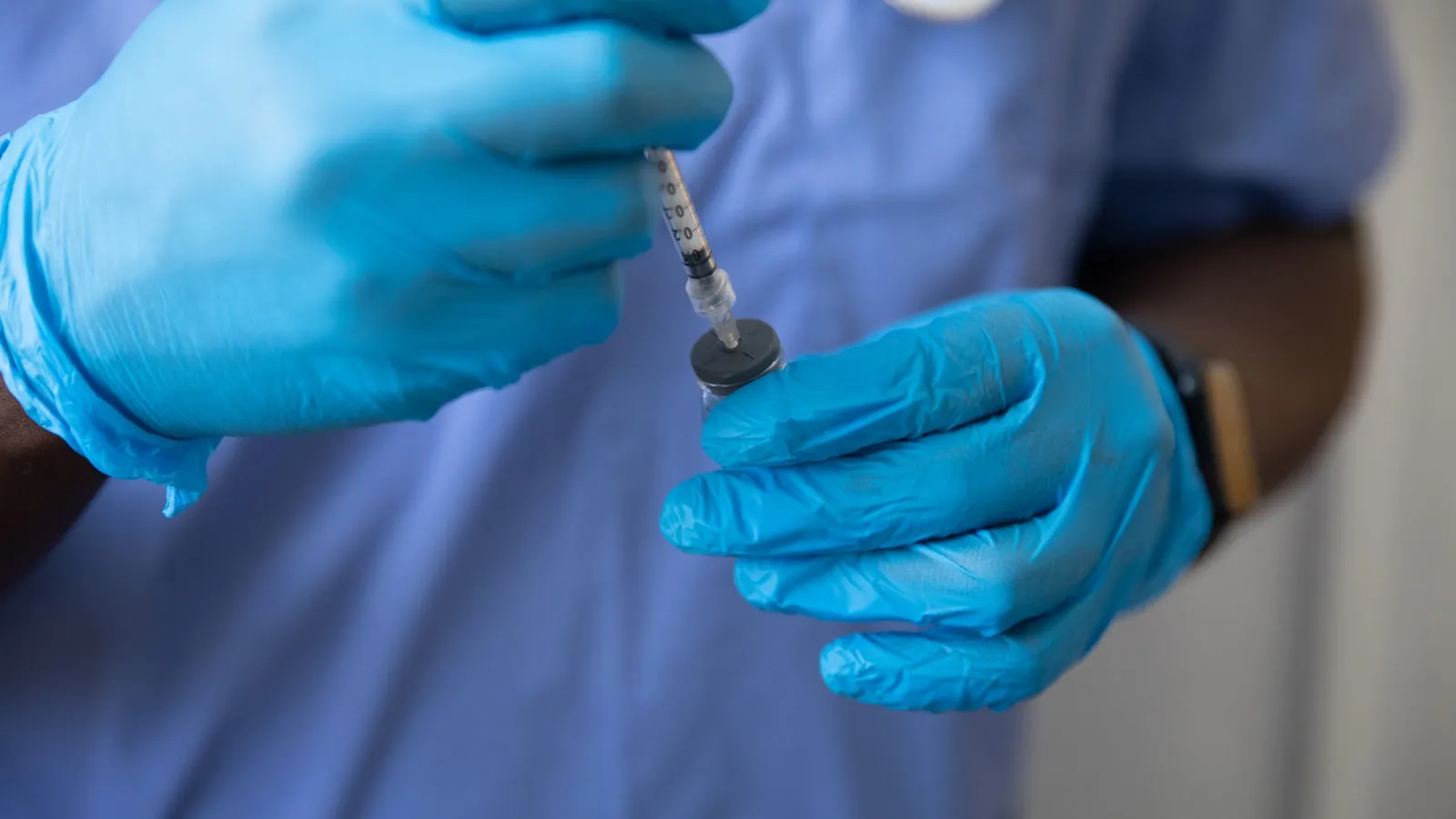
Nebido is a testosterone injection that lasts about a quarter of a year. The active substance is testosterone undecanoate, an ampoule holds 1000 mg in 4 ml, and a doctor injects it slowly into the buttock muscle. The first injection is usually followed by a second after roughly six weeks, after which the interval moves to 10 to 14 weeks.
Four injections a year, then. That is the whole schedule.
What men starting on it almost never hear is that those twelve weeks do not behave like one flat line. There is a peak and there is a trough, and the gap between them explains why week 4 feels different from week 11.
How does Nebido work in your body?
Nebido is testosterone attached to a long fatty-acid tail, dissolved in castor oil. That combination lets the drug leave the muscle slowly. Your liver clips the tail off, and what remains is plain testosterone, the same molecule your testicles make.
That slow release is the entire point of this preparation. Short-acting testosterone esters call for an injection every one or two weeks.
Schubert and colleagues described the pharmacokinetics in the Journal of Clinical Endocrinology and Metabolism in 2004. Wang and colleagues followed a group of men for 84 weeks in 2010 and found the level returns fairly predictably after the loading phase.
The Farmacotherapeutisch Kompas covers the preparation, the dosing and the contraindications in sober Dutch. Useful to read alongside your own prescription.
How does the level run across twelve weeks?
After the injection your testosterone climbs to a peak in about a week, stays high for several weeks and then drifts back down. Towards the end of the interval you sit at your lowest point, the trough. That pattern is why doctors often draw blood just before the next injection.
| Period | What happens to your level | What men often report |
|---|---|---|
| Week 1 | fast climb to the peak | sometimes headache, a full feeling, pain at the injection site |
| Week 2 to 6 | high and reasonably stable | the stretch most describe as the best |
| Week 7 to 10 | gradual decline | usually unremarkable |
| Week 11 to 14 | trough, the lowest point of the interval | tiredness or low drive returning, varies widely |
That table is an average, not a promise. How fast you clear the drug depends on your weight, your body fat and your own metabolism.
Picture two men who both land on 22 nmol/l, one in week 2 and the other in week 12. The same result, and yet the first sits at his peak and the second at his lowest point.
What it means in practice: a result says little without the date of your last injection next to it. A doctor would read that number very differently for the second man than for the first.
Which side effects are reported most?
The product information lists acne, pain at the injection site, a rise in red blood cells, fluid retention and tender breast tissue as the most reported side effects. Mood swings and oilier skin appear too. How often they occur differs sharply per man.
One rare side effect belongs specifically to this type of oil injection. A small amount of the oil can enter the bloodstream during injection, which shortly afterwards can cause coughing, breathlessness or dizziness. That is why you usually stay in the waiting room for a while after the shot.
This is no reason to panic, but it is the reason the drug is given by a healthcare professional rather than at home.
Tender breast tissue happens because part of your testosterone converts into oestradiol. Our piece on gynaecomastia in men explains what goes on there.
What does Nebido do to your haematocrit?
Testosterone prompts your bone marrow to make more red blood cells, which can raise your haematocrit. With injections that happens more often and more strongly than with a gel. That is why this value is followed in nearly every course of this treatment.
Ohlander and colleagues mapped this in Sexual Medicine Reviews in 2018 and saw the injection-versus-gel difference clearly. Jones and colleagues described the same pattern in older men in 2015.
The good thing about haematocrit is that it is simply a number on your result. You do not need to feel anything to see it coming. Our marker page on haematocrit explains what the value means.
What does Nebido do to your fertility?
Testosterone from outside suppresses the signals that drive sperm production. Your brain dials LH and FSH back, and without those two the production of sperm cells in your testicles largely stops. In many men the count drops sharply, sometimes to near zero.
Fusco and colleagues described that mechanism in 2021. Crosnoe and colleagues already called external testosterone a preventable cause of male infertility in 2013.
This applies to every form of testosterone therapy, so to gels and capsules as well. It is not something specific to Nebido.
If you want children, this is the conversation that belongs before the first injection. Our piece on clomiphene in men covers a route that handles this differently.
Nebido, gel or Sustanon: where is the difference?
The difference is mostly rhythm. Nebido gives you a long, reasonably flat curve across four moments a year. A gel gives a daily fluctuation you control yourself. Sustanon sits in between, with an injection every two to three weeks and a clearer peak and trough.
Which suits you depends on your preference, your skin, your household and your doctor. Someone with young children at home looks at a gel differently, because it can transfer through skin contact.
We wrote about that separately in testosterone gel and transfer, and about the ester mix in Sustanon.
The wider picture across all forms sits in our guide to TRT and testosterone therapy.
What can you have measured yourself?
You can have your testosterone measured to record a baseline, or to see where you sit in the interval. Always note the date of your last injection, because without it the result is hard to place.
A testosterone test gives you that value. The marker pages on total testosterone and LH explain what the numbers mean.
I would never read a result apart from your treating doctor. On this treatment the meaning of a number hangs entirely on when it was drawn.
If something is not running the way you expected, take your result and your injection dates into the appointment. That gets you further than the result alone.
Every blood test result includes a professional assessment from a BIG-registered doctor. For treatment decisions, discuss your results with your GP.
References
- Schubert M, et al. Intramuscular testosterone undecanoate: pharmacokinetic aspects during long-term treatment of men with hypogonadism. Journal of Clinical Endocrinology and Metabolism, 2004. PMID 15531493
- Wang C, et al. Pharmacokinetics and safety of long-acting testosterone undecanoate injections in hypogonadal men. Journal of Andrology, 2010. PMID 20133964
- Ohlander SJ, et al. Erythrocytosis following testosterone therapy. Sexual Medicine Reviews, 2018. PMID 28526632
- Jones SD Jr, et al. Erythrocytosis and polycythemia secondary to testosterone replacement therapy in the ageing male. Sexual Medicine Reviews, 2015. PMID 27784544
- Fusco F, et al. Suppression of spermatogenesis by exogenous testosterone. Current Pharmaceutical Design, 2021. PMID 33292112
- Crosnoe LE, et al. Exogenous testosterone: a preventable cause of male infertility. Translational Andrology and Urology, 2013. PMID 26813847
- Farmacotherapeutisch Kompas, testosterone undecanoate monograph. Accessed 2026.
Author
Caliberhealth
Dr. Naimi, BIG-registered physician, oversees the medical standards behind our content and assessments. Read our medical policy