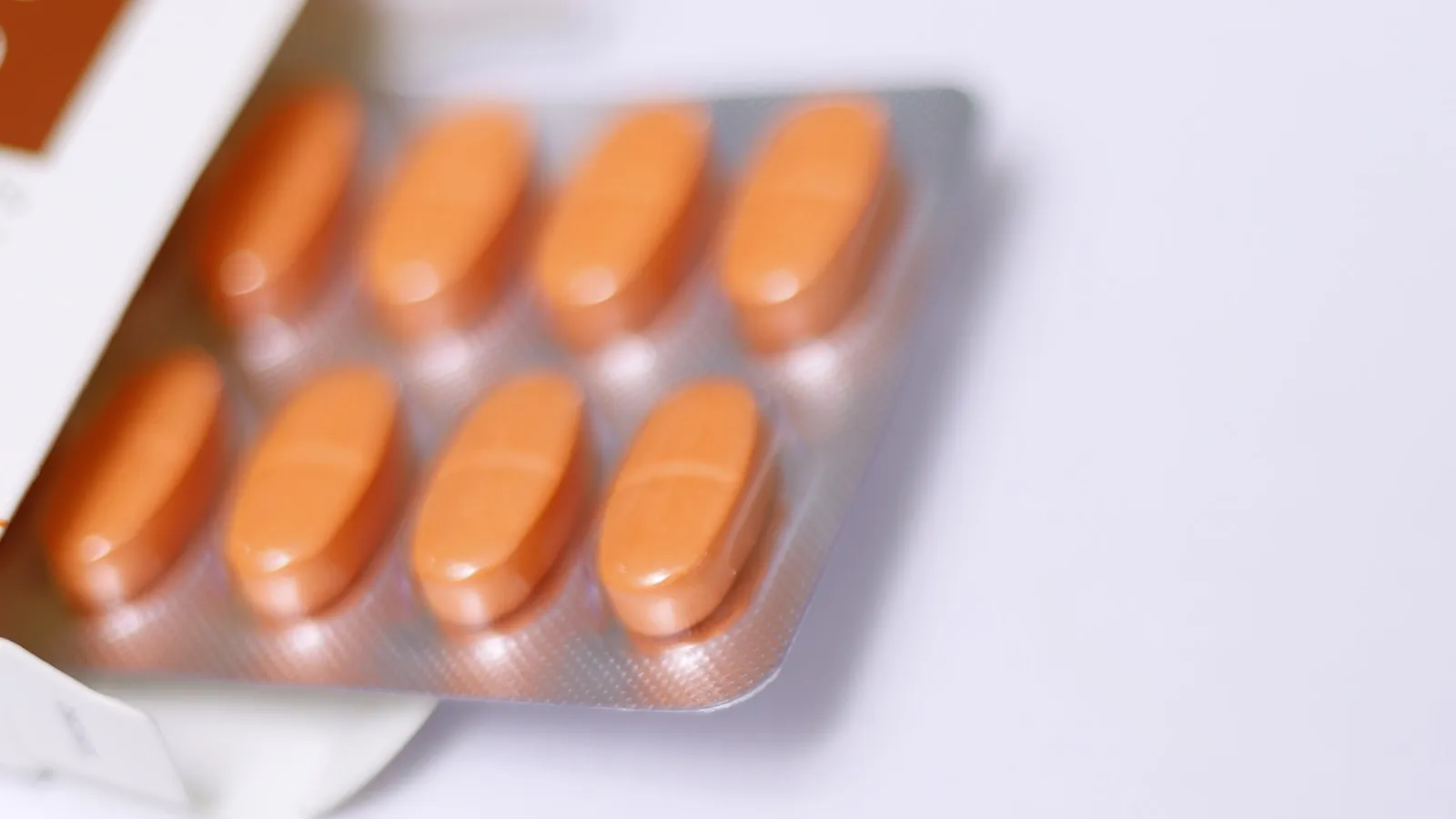
Sustanon 250 is a testosterone injection that holds four different esters rather than one. Each millilitre carries 250 mg of testosterone in total, split across one fast, two medium and one slow ester, dissolved in arachis oil. A doctor usually injects it into the muscle every two to three weeks.
Those four esters are the whole story of this drug.
They do not release together. The fastest is spent within a few days, the slowest takes more than a week, and that layering is why your level shoots up after an injection and then falls back in stages.
What exactly is in Sustanon 250?
Sustanon 250 contains testosterone propionate, testosterone phenylpropionate, testosterone isocaproate and testosterone decanoate. All four carry the same testosterone molecule with a different tail attached. The longer the tail, the more slowly the drug leaves the muscle tissue.
| Ester | Amount per ml | Approximate duration |
|---|---|---|
| Testosterone propionate | 30 mg | short, around a day |
| Testosterone phenylpropionate | 60 mg | several days |
| Testosterone isocaproate | 60 mg | a little over half a week |
| Testosterone decanoate | 100 mg | around a week |
The durations in that table are approximations from the product information, not exact values. They differ per person.
There is one more detail you should not miss. The solution contains arachis oil, which is peanut oil, so it is unsuitable for people with a peanut allergy. The Farmacotherapeutisch Kompas names that explicitly among the contraindications.
How does your level run after a Sustanon injection?
Your testosterone climbs sharply within one to two days, stays high for about a week and then steps back down towards the trough. On a three-week interval you often sit clearly lower in the final week than in the first. Some men notice that difference, others do not.
Compare it with Nebido, which uses one slow ester and gives a long, flat curve instead. Sustanon trades that flatness for a faster start.
Picture two men on the same schedule, one drawn on day 3 and the other on day 18. Both come out at 30 nmol/l, and yet that number says something entirely different.
For blood work it means what it means with any injection: without the date of your last shot a result is hard to read.
How the other injectable behaves is covered in Nebido experiences.
Which side effects are reported with Sustanon?
The most reported side effects are acne, pain and irritation at the injection site, fluid retention, tender breast tissue and a rise in red blood cells. Mood swings appear too. On a shorter interval some men clearly feel the peak after the shot.
The rise in red blood cells is more pronounced with injections than with gels. Ohlander and colleagues mapped that in Sexual Medicine Reviews in 2018.
Tender breast tissue arises because part of your testosterone converts into oestradiol, and that goes faster the higher the peak. More on that in gynaecomastia in men.
What happens to your fertility applies to every form of external testosterone. Fusco and colleagues described in 2021 how sperm production largely stops as a result.
Sustanon on prescription or Sustanon in a cycle: what is the difference?
The difference is not the drug but the dose, the supervision and the goal. On prescription a doctor aims for a level inside the normal adult male range, with blood monitoring alongside. In a cycle much higher doses are used, often combined with other compounds, usually outside of healthcare.
Sustanon is one of the drugs that shows up in both worlds. That makes the name confusing, because the same ampoule can belong to two entirely different situations.
The Netherlands has unusually good data here. The HAARLEM study followed a group of Dutch men before, during and after a self-run cycle.
Smit summarised the findings in 2022. There were clearly measurable changes in blood lipids, in haematocrit and in testicular function, and they did not fully recover in everyone. De Ronde described what happens to testicular function specifically in the same year.
Smit had already published an overview of the Dutch outpatient clinic these users can attend in 2018. That such a clinic exists says enough about how often this happens.
Which blood values move with it?
On testosterone at high doses it is mainly your haematocrit, your blood lipids and your own hormone signals that move. LH and FSH fall away because your brain dials back your own production, and HDL cholesterol often drops. These are values you simply see printed on a result.
That is the practical value of the HAARLEM numbers, even for someone who never runs a cycle. They show which list moves with testosterone, and that is exactly the list a careful treatment follows.
What the individual values mean is on our marker pages for haematocrit, total testosterone and LH.
If you want to record where you stand, a testosterone test will do it. Take the result to your doctor rather than weighing it yourself.
What it comes down to
Sustanon is not a mysterious compound, it is testosterone at four speeds. That build explains the curve after an injection, and it explains why the timing of a blood draw matters so much.
My point about this drug is mainly this: let your blood be watched, whichever route you take. The values that change are cheap to measure and you will not feel them coming.
The wider overview of every form of testosterone therapy sits in our guide to TRT, and the daily version in testosterone gel.
Every blood test result includes a professional assessment from a BIG-registered doctor. For treatment decisions, discuss your results with your GP.
References
- Smit DL, et al. Health effects of androgen abuse: a review of the HAARLEM study. Current Opinion in Endocrinology, Diabetes and Obesity, 2022. PMID 35938779
- de Ronde W, et al. Anabolic-androgenic steroid abuse and testicular function in men. Current Opinion in Pharmacology, 2022. PMID 36410315
- Smit DL, et al. Outpatient clinic for users of anabolic androgenic steroids: an overview. Netherlands Journal of Medicine, 2018. PMID 29845939
- Ohlander SJ, et al. Erythrocytosis following testosterone therapy. Sexual Medicine Reviews, 2018. PMID 28526632
- Fusco F, et al. Suppression of spermatogenesis by exogenous testosterone. Current Pharmaceutical Design, 2021. PMID 33292112
- Bhasin S, et al. Testosterone therapy in men with hypogonadism. Journal of Clinical Endocrinology and Metabolism, 2018. PMID 29562364
- Farmacotherapeutisch Kompas, testosterone ester monograph. Accessed 2026.
Autor
Caliberhealth
Dr. Naimi, lekarz wpisany do holenderskiego rejestru BIG, nadzoruje standardy medyczne naszych treści i ocen. Przeczytaj naszą politykę medyczną