Testing testosterone sounds simple: draw some blood, read a number. But the same blood can read 16 nmol/l in the morning and 11 nmol/l in the afternoon. Same body, two very different conclusions.
That gap isn't about you, it's about when and how you measure. And that's exactly where it often goes wrong.
What strikes me when I talk to men: almost everyone chases the number, almost nobody chases the conditions. Line up these six points first, so your test actually says something.
How can I get my testosterone tested?
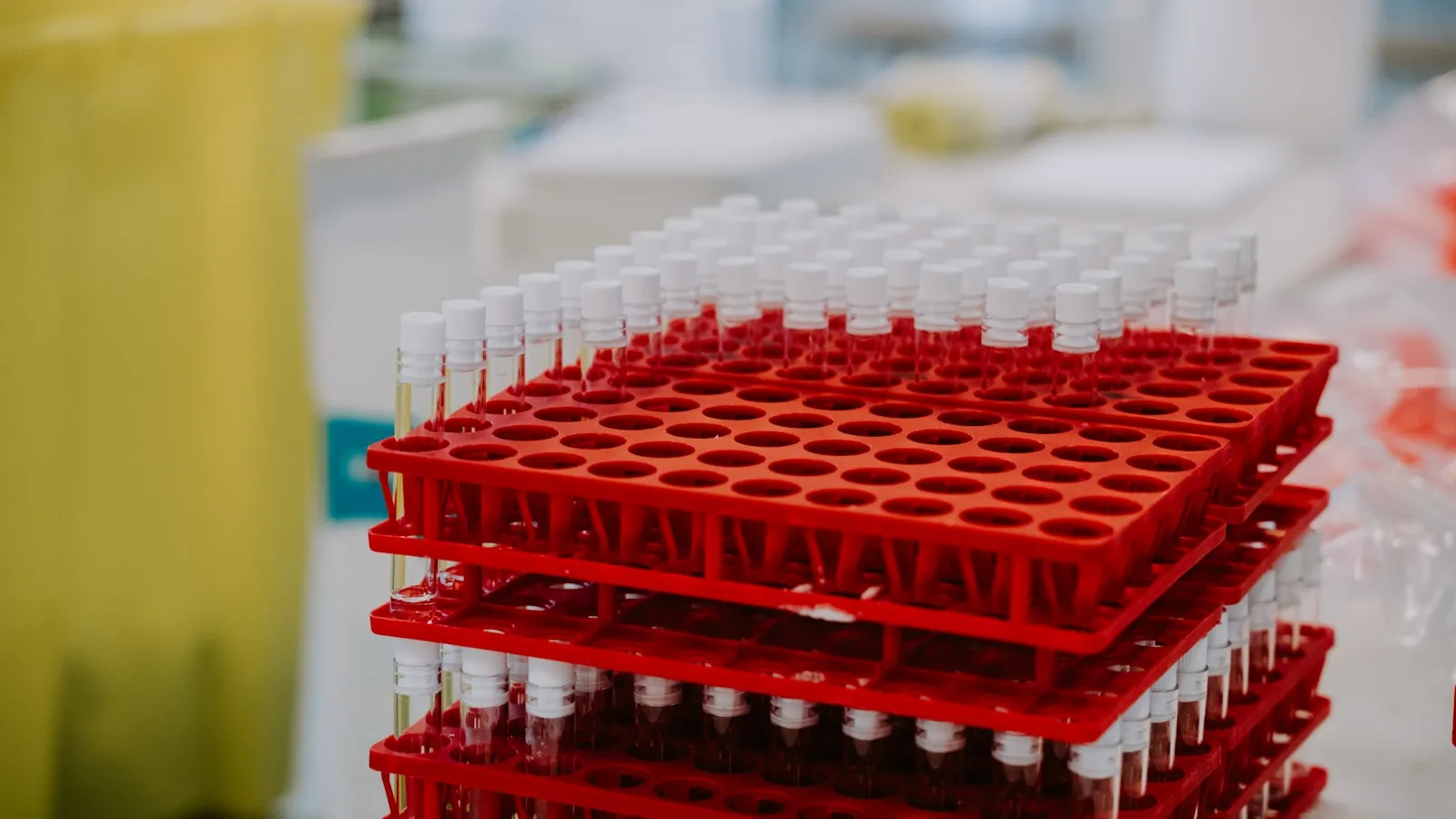
You test testosterone with a blood draw, ideally between 7am and 10am, fasted and on a quiet day. Your GP can order it, and there are blood tests you book yourself. What matters more than where you draw is under which conditions you draw.
At the GP, testosterone usually belongs to a bigger story: your symptoms, a physical exam, sometimes other hormones alongside. That is the route if you have specific concerns.
If you choose a blood test you arrange yourself, you pick the timing. That is an advantage, because the timing genuinely matters.
My advice: don't set the bar at the needle, set it at the preparation.
1. Testing testosterone: choose a morning blood draw (7am to 10am)
Testosterone follows a daily rhythm. In healthy men it peaks early in the morning and drifts down over the day. Draw in the afternoon and you often read a lower number, without anything being wrong.
In a study of young and middle-aged men, the peak of total, free and bioavailable testosterone fell between 07.00 and 07.30 (Diver, 2003). That rhythm stayed visible into later life.
Take a man who draws at 3pm and reads 11 nmol/l. He panics, and repeats it a week later at 8am: 16 nmol/l. Nothing changed in his body, only on the clock.
So draw early, and ideally around the same time each time.
2. Total and free testosterone are not the same
Your result often shows two numbers: total testosterone and free testosterone. The total is everything together. The free part is the slice that isn't bound to proteins and can do its work.
That difference comes from SHBG, a protein that binds testosterone. If your SHBG is high, your total can look normal while your free testosterone is low. If your SHBG is low, the opposite often happens.
Free testosterone is usually calculated from total testosterone and SHBG (Vermeulen, 1999). That is why SHBG belongs on the panel, not as trivia but as a calculation factor.
Measure only the total testosterone and you miss that context. Two men with the same total of 15 nmol/l can have very different free testosterone.
3. Measure fasted and under steady conditions
Eating changes your testosterone temporarily. In a study of healthy men, total testosterone dropped after a glucose drink and after a meal, then recovered again (Gagliano-Juca, 2019).
Draw right after breakfast and your number can come out a little lower. Not dramatic, but enough to add noise to a test you take seriously.
Measuring fasted removes that variable. The same goes for a night of bad sleep, a hard workout the evening before, or a heavy hangover.
The duller the day before, the more reliable the test.
4. One measurement is too few, plan two on separate days
Testosterone also swings from day to day, apart from the clock. That same man can be 14 nmol/l on Monday and 12 on Thursday, with nothing having changed.
Research into that swing showed that the biological variation between days is larger than the lab's own measurement error (Brambilla, 2007). So a single number can be high or low by chance.
That is why doctors rarely lean on one result. A second measurement on another day, again in the morning, shows whether a low value is structural or an outlier.
I get that two draws is annoying. But one test you read wrongly costs you more.
5. Extra values add context (LH, FSH, SHBG, prolactin)
A testosterone number alone doesn't tell you where a low value comes from. LH and FSH, two hormones from your pituitary, show whether the signal from above is right. SHBG colours the free part, and prolactin can play a role with certain symptoms.
If your LH and FSH are high while your testosterone is low, that points more towards the testicles. If they are low or low-normal, the cause sits higher up, in the signalling.
You don't make that distinction with a single value. That is why a good hormone panel holds more than testosterone alone.
| What you measure | What it says | Why measuring it alone can mislead |
|---|---|---|
| Total testosterone | All testosterone together | Says nothing about how much is free and active |
| Free testosterone | The part that can do its work | It is calculated, and depends heavily on SHBG |
| SHBG | The protein that binds testosterone | High or low can distort the total |
| LH | Signalling from the pituitary | Without LH you don't know where a low value comes from |
| FSH | Signal towards the testicles | Only useful next to testosterone and LH |
6. A number is not yet a diagnosis
A low result doesn't automatically mean you have a problem, and a normal result rules nothing out. Your symptoms, your story and several values together decide the picture, not a single figure.
The Dutch College of General Practitioners (NHG) treats testosterone as part of that bigger picture, not as a standalone dial. That is the healthiest way to look at it, in my view.
So discuss your results with your GP. They can help you work out whether further steps are needed, and which.
If you want your testosterone mapped properly, the Testosterone Panel measures your total and free testosterone plus SHBG in one draw. That way the context comes with it.
If you would rather start small, a standalone testosterone test measures total testosterone only. If you suspect SHBG is skewing your result, the free testosterone test reports the active fraction separately.
Want the background first? Read our complete guide to testosterone, or dig into the causes of low testosterone and what counts as normal by age.
Recognise the signals yourself? Start with the ten signs of low testosterone, or see the wider picture in men's hormonal health.
References
- Diver MJ, Imtiaz KE, Ahmad AM, Vora JP, Fraser WD. Diurnal rhythms of serum total, free and bioavailable testosterone and of SHBG in middle-aged men compared with those in young men. Clin Endocrinol (Oxf). 2003;58(6):710-717. PMID 12780747.
- Vermeulen A, Verdonck L, Kaufman JM. A critical evaluation of simple methods for the estimation of free testosterone in serum. J Clin Endocrinol Metab. 1999;84(10):3666-3672. PMID 10523012.
- Gagliano-Juca T, Li Z, Pencina KM, et al. Oral glucose load and mixed meal feeding lowers testosterone levels in healthy eugonadal men. Endocrine. 2019;63(1):149-156. PMID 30191441.
- Brambilla DJ, O'Donnell AB, Matsumoto AM, McKinlay JB. Intraindividual variation in levels of serum testosterone and other reproductive and adrenal hormones in men. Clin Endocrinol (Oxf). 2007;67(6):853-862. PMID 18052942.
- Dutch College of General Practitioners (NHG). General-practice principles for hormone testing and interpreting blood values.
Disclaimer
Caliberhealth works with BIG-registered doctors who review your blood results. This article offers general information and does not replace medical advice from your GP or specialist. A blood test is a tool, not a diagnosis on its own. For persistent or serious symptoms, contact your GP, or call 112 in an emergency.
الكاتب