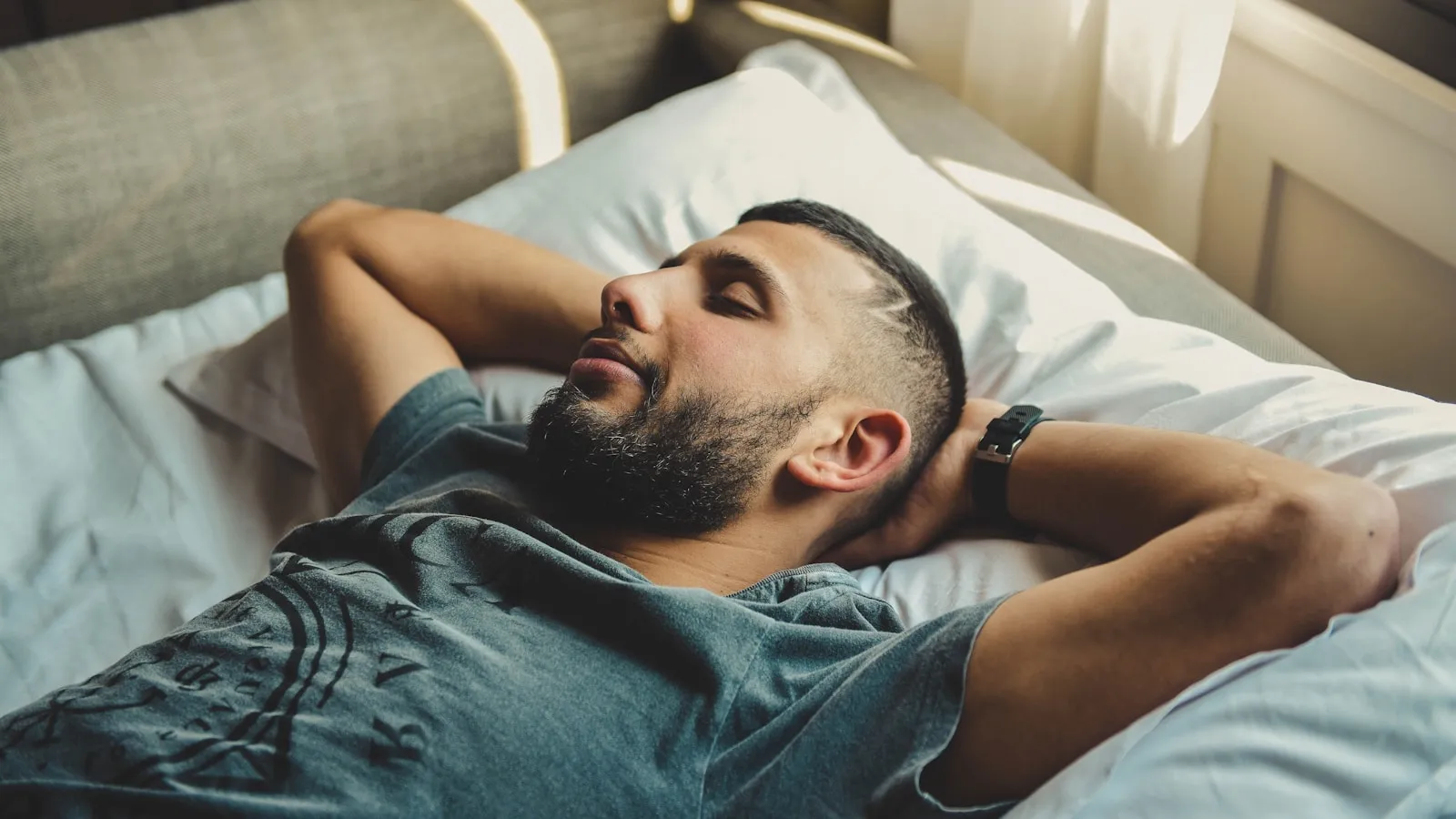
Sleep apnea is a condition in which your breathing repeatedly stops during sleep, often dozens of times an hour, without you ever waking up properly. In men it occurs roughly twice as often as in women. In the Swiss HypnoLaus study, 49.7 percent of men aged 40 to 85 had a moderate to severe form, against 23.4 percent of women.
That number stuck with me the first time I read it.
Because almost nobody walks in with this complaint. Men book a hormone test because they are tired, because their sex drive has gone, because they have gained weight around the middle and lost their edge at work. All four fit a pattern of breathing that stalls hundreds of times a night. And not one of them has ever had the subject raised.
This article is about that. What sleep apnea is, why male bodies are more prone to it, which complaints belong to it and which blood values shift alongside it. Plus, and this matters, what a blood test can and cannot do here.
What exactly is sleep apnea?
Sleep apnea means your breathing repeatedly stops or drops sharply while you sleep. In the obstructive form the wall of your throat collapses while your chest keeps working. Your oxygen level falls, your brain wakes you very briefly to reopen the airway, and the pattern repeats all night.
Those brief wake-ups are called arousals. You do not remember them. You only notice the result: you spend eight hours in bed and get up as though you had five.
Doctors express severity as the apnea-hypopnea index, or AHI. That is the average number of breathing stops per hour of sleep. Five to fifteen is mild, fifteen to thirty moderate, above thirty severe. An AHI of thirty means your breathing falters every two minutes.
There is also central sleep apnea, where the signal from your brainstem drops out instead of your throat closing. That form is far rarer and more often linked to heart failure or certain medication. When someone says sleep apnea, they almost always mean the obstructive kind.
Benjafield and colleagues estimated in 2019 that almost a billion people aged 30 to 69 worldwide have obstructive sleep apnea, roughly 425 million of them in the moderate to severe range. This is not a fringe condition.
Why is sleep apnea more common in men?
Men have a longer and narrower throat than women, store fat around the neck and belly sooner, and have different muscle tone in the upper airway during sleep. Those three differences together explain why almost every population study shows a clear male majority.
It goes beyond anatomy. Belly fat presses against your diaphragm when you lie down and reduces lung volume, which makes the airway less stable. Neck circumference is therefore a better predictor than weight alone. In men, a neck circumference from around 43 centimetres is treated as raised risk.
Alcohol plays a part too. It relaxes the muscles in your throat at exactly the moment you need them. Two drinks in the evening can be the difference between snoring and genuine breathing stops in someone already borderline.
Then there is the age question. Risk climbs until around sixty and levels off after that. Which means the group it hits hardest, men from 40 to 60, is precisely the group least likely to call a doctor about how they sleep.
The causes and risk factors are covered in more depth in our piece on sleep apnea causes.
What are the symptoms of sleep apnea?
The complaints split into two groups: what your partner sees at night and what you feel during the day. The night-time signals are more specific, the daytime ones are what eventually take you to a doctor. The table below sets them side by side.
| At night (usually noticed by your partner) | During the day (what you notice) |
|---|---|
| Loud, irregular snoring with silences in between | Sleepiness that does not lift after a lie-in |
| Visible breathing stops, sometimes with gasping | Headache on waking |
| Restless tossing and frequent position changes | Trouble concentrating and losing words |
| Getting up to urinate several times a night | Short temper and low mood |
| Night sweats | Reduced sex drive and weaker erections |
| Dry mouth or sore throat on waking | Nodding off at the television, in meetings, at traffic lights |
The awkward part is that every one of those daytime complaints also fits ten other things. Anaemia, an underactive thyroid, depression, simply too few hours in bed. That is why sleep apnea is missed so often in men: the complaint you report is fatigue, and the cause lies in a room you are not conscious in.
Which daytime symptoms are most characteristic, and how to tell them from ordinary sleep deprivation, is covered in sleep apnea daytime symptoms.
What does sleep apnea do to your body?
Every breathing stop brings a short drop in oxygen and a surge of stress. Your heart rate and blood pressure spike, stress hormones are released, and this happens hundreds of times a night, year after year. The body simply does not get the recovery it is built to expect.
The best-established consequences involve the heart and blood vessels. Peppard and colleagues followed more than seven hundred people in the Wisconsin Sleep Cohort for four years and found that the odds of developing new high blood pressure rose with the AHI, even after correcting for weight, age, smoking and alcohol. That study appeared in the New England Journal of Medicine in 2000 and still stands.
The Dutch Heart Foundation, Hartstichting, accordingly lists sleep apnea among the factors associated with high blood pressure and heart rhythm disorders. If your blood pressure stays high despite medication and lifestyle, how you sleep is one of the things a doctor can bring into the picture.
Then there is the metabolic side. Repeated oxygen dips and fragmented sleep reduce insulin sensitivity, which can push your blood sugar and eventually your HbA1c upward. What that value actually says is explained in blood sugar in men.
For a plain-language Dutch explanation of sleep apnea and what a GP does with it, Thuisarts is the best starting point. That page is written for patients rather than for clinicians.
Which blood values change with sleep apnea?
No blood value proves sleep apnea. A few do shift alongside it, partly as a result of the night-time oxygen dips and partly because conditions that mimic apnea are themselves visible in blood. Those two things are not the same, and the difference is worth having.
| Value | How it relates to sleep apnea |
|---|---|
| Haematocrit and haemoglobin | Can rise as the body responds to sustained oxygen dips by making more red blood cells |
| Total and free testosterone | Sit lower on average in men with untreated apnea, partly through the disrupted night-time production peak |
| HbA1c and fasting glucose | Move with the reduced insulin sensitivity that accompanies untreated apnea |
| TSH and FT4 | An underactive thyroid produces complaints resembling apnea and can worsen the condition itself |
| Ferritin and iron | A deficiency causes fatigue and restless legs, two complaints commonly confused with apnea |
Here is how to read that table: no single row proves anything. They show which traces apnea leaves behind and which alternative explanations blood can actually rule out. The second is the more useful in practice. If you are tired and your thyroid, iron, blood sugar and testosterone all come back fine, the question of how you breathe while asleep suddenly becomes a great deal more relevant.
Take two men of 45 arriving with precisely the same complaint, tired for months and little interest in sex. In one, TSH comes back at 6.8 and testosterone at 9 nmol/l, and there sits an explanation that blood finds for you. In the other everything is entirely normal, and his oxygen drops to 84 percent during the night. Same complaint, two completely different routes, and only the first man's blood points the way.
What is measured is set out on the marker pages for total testosterone and haematocrit. For a broader picture there is the male hormone panel or the extended health checkup.
What is the relationship between sleep apnea and testosterone?
The relationship runs both ways, which is what makes it confusing. Untreated sleep apnea lowers your testosterone, because the largest production peak falls in deep sleep and that sleep gets fragmented. At the same time, testosterone from outside can affect breathing control and worsen apnea in some men.
Zhang and colleagues pooled the studies on CPAP treatment and testosterone in 2014. Their conclusion was cautious: CPAP alone produced no convincing rise, while weight loss did. Put differently, the machine repairs the night, but the belly fat keeps pulling on your hormones.
The other direction matters at least as much for our readers. Hoyos and colleagues gave eighteen weeks of testosterone to men with obesity and severe sleep apnea in 2012. Breathing during sleep measurably worsened in the early weeks, though that effect was no longer significant at eighteen weeks. Melehan and colleagues, working with the same cohort in 2016, did find a clear increase in sexual desire.
For a man turning up at a clinic with fatigue and a flat libido, that means something concrete. If the underlying cause is apnea, testosterone from outside is not automatically the obvious first step. It is a reason to know how you sleep before you go home with a prescription.
How testosterone therapy works in the Netherlands and what a doctor monitors is covered in TRT explained. The signals of a low value are in low testosterone in men, and the night-time side in poor sleep and your testosterone.
Can sleep apnea cause erection problems?
Yes, there is a consistent association. Kellesarian and colleagues brought the available studies together in 2018 and found erectile dysfunction to be more common in men with obstructive sleep apnea than in men without it. This is an association, not a proven causal link in both directions.
The explanation most often given combines three routes: reduced blood vessel wall function from repeated oxygen dips, lower testosterone, and the fatigue and low mood that undermine desire anyway.
Li and colleagues looked at what treatment does in 2019. Both CPAP and erectile dysfunction medication improved erectile scores, and the combination did better than either alone. That is one of the few places where the literature turns genuinely practical.
What else can sit behind erection problems is covered in erectile dysfunction.
How do you find out whether you have sleep apnea?
Sleep apnea is established with a sleep study, not with blood and not with a questionnaire. There is, however, a validated tool for judging whether that study is worth doing: STOP-BANG, developed by Chung and colleagues in 2008 and used in dozens of countries since.
The eight questions are below. They are not accidentally male-relevant: sex, neck circumference and age are all in there.
- Snoring: do you snore loudly, audible through a closed door?
- Tired: are you often tired or sleepy during the day?
- Observed: has anyone seen you stop breathing?
- Pressure: do you have high blood pressure or treatment for it?
- BMI: is your BMI above 35?
- Age: are you over 50?
- Neck: is your neck circumference above 40 centimetres?
- Gender: are you male?
Three or more yes answers count as raised likelihood in the original study. The list is deliberately tuned to be sensitive, which means it misses few cases but also flags people who turn out to have nothing. It is a reason for a conversation with your doctor, not a result.
What the actual investigation looks like, from a home recording to a night in a sleep centre, is covered in sleep study.
What can you do about sleep apnea yourself?
The measure with the strongest evidence is weight loss. In the Sleep AHEAD study, Kuna and colleagues followed people with obesity and type 2 diabetes for four years, and the group on an intensive lifestyle programme maintained a lower AHI than the control group. The effect tracked how much weight actually stayed off.
Beyond that, sleeping on your side rather than your back helps a subset of men, and cutting evening alcohol makes a difference. None of this replaces treatment for a confirmed moderate or severe form. It does matter for mild complaints and alongside treatment.
The treatments themselves, from CPAP to a mandibular device and positional therapy, are compared in sleep apnea device. What to do about snoring without apnea is in how to stop snoring.
On the belly fat: that is not a matter of willpower alone and the hormonal side counts. What does and does not work is covered in losing belly fat as a man.
What it comes down to
In men over forty, sleep apnea is closer to the rule than the exception, and it disguises itself as something else. As fatigue, as a flat libido, as blood pressure that will not come down, as a testosterone value sitting at the bottom of the range.
My point with this piece is not that you should assume you have apnea. It is that the subject belongs on the table when those complaints show up together, and that for almost nobody does it get there.
Blood cannot demonstrate sleep apnea. What blood can do is bring the other explanations for your fatigue into view, and show what is happening to your hormones and blood sugar in the meantime. If the question is still standing afterwards, ask your doctor what a sleep study would add in your case.
If you sleep badly and cannot place why, start by recording a baseline with the male hormone panel and take the result into that conversation.
Every blood test result includes a professional assessment from a BIG-registered doctor. For treatment decisions, discuss your results with your GP.
References
- Heinzer R, et al. Prevalence of sleep-disordered breathing in the general population: the HypnoLaus study. The Lancet Respiratory Medicine, 2015. PMID 25682233
- Benjafield AV, et al. Estimation of the global prevalence and burden of obstructive sleep apnoea. The Lancet Respiratory Medicine, 2019. PMID 31300334
- Peppard PE, et al. Prospective study of the association between sleep-disordered breathing and hypertension. New England Journal of Medicine, 2000. PMID 10805822
- Zhang XB, et al. Efficacy of continuous positive airway pressure on testosterone in men with obstructive sleep apnea: a meta-analysis. PLoS One, 2014. PMID 25503098
- Hoyos CM, et al. Body compositional and cardiometabolic effects of testosterone therapy in obese men with severe obstructive sleep apnoea. European Journal of Endocrinology, 2012. PMID 22848006
- Melehan KL, et al. Increased sexual desire with exogenous testosterone administration in men with obstructive sleep apnea. Andrology, 2016. PMID 26610430
- Kellesarian SV, et al. Association between obstructive sleep apnea and erectile dysfunction. International Journal of Impotence Research, 2018. PMID 29795528
- Li Z, et al. The effect of CPAP and PDE5i on erectile function in men with obstructive sleep apnea and erectile dysfunction. Sleep Medicine Reviews, 2019. PMID 31715462
- Chung F, et al. STOP questionnaire: a tool to screen patients for obstructive sleep apnea. Anesthesiology, 2008. PMID 18431116
- Kuna ST, et al. Long-term effect of weight loss on obstructive sleep apnea severity in obese patients with type 2 diabetes. Sleep, 2013. PMID 23633746
الكاتب
Caliberhealth
Dr. Naimi، طبيب مسجل في سجل BIG الهولندي، يشرف على المعايير الطبية لمحتوانا وتقييماتنا. اقرأ سياستنا الطبية