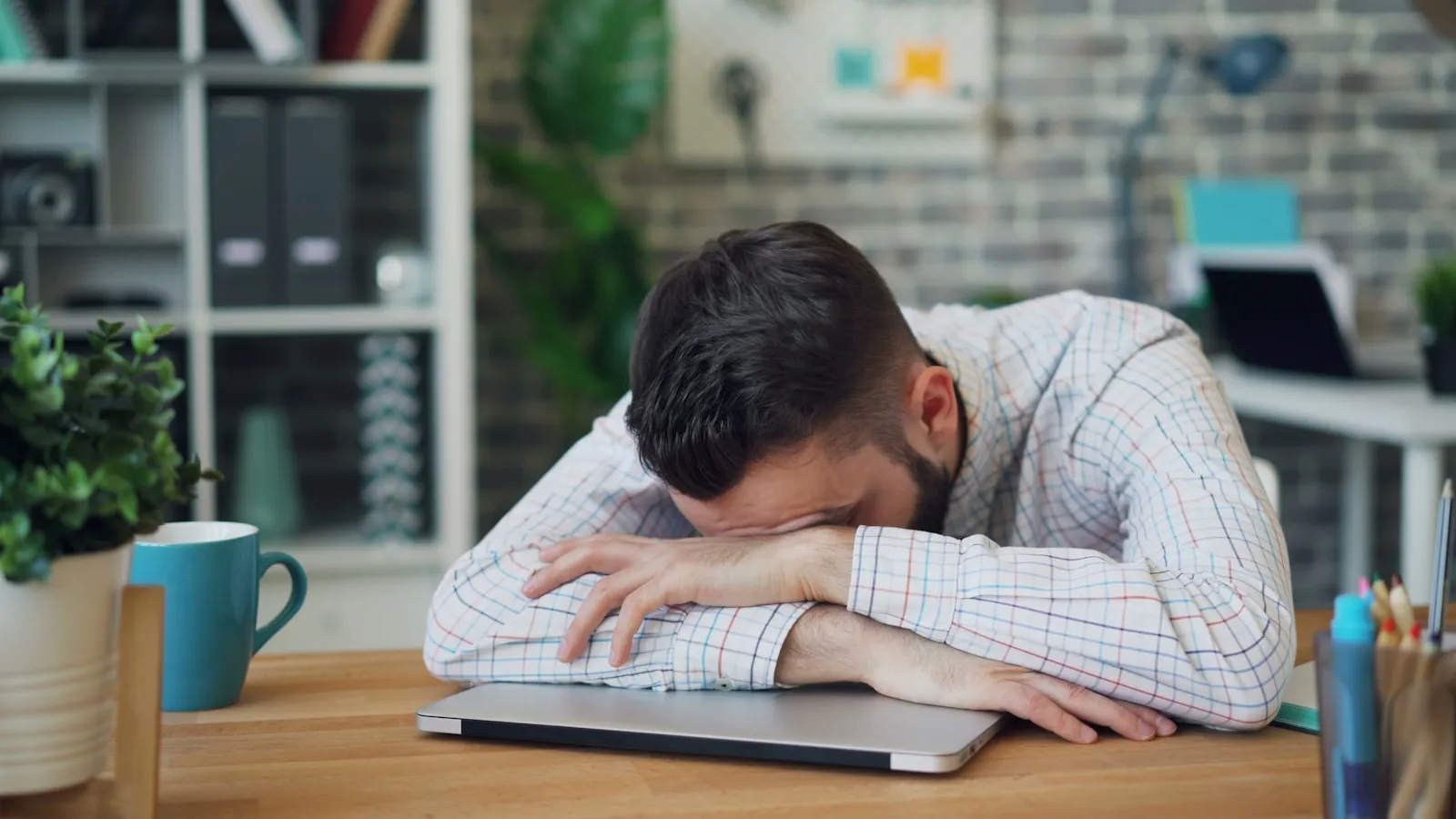
Sleep apnea daytime symptoms are sleepiness that does not lift after a lie-in, headache on waking, trouble concentrating, a short temper and reduced interest in sex. Every one of them is vague, and that is exactly the problem: no single symptom points at your breathing on its own.
The night is the part you do not notice. The hundreds of brief wake-ups with which your brain reopens your airway, you remember none of them.
What you do notice is that you spent eight hours in bed and got four. This piece is about what those daytime complaints look like, how to tell them from simply not sleeping enough, and when it is time to act.
Why are you so tired during the day with sleep apnea?
You do sleep, but you sleep in fragments. Every breathing stop ends in a brief wake-up that interrupts deep sleep before it can do its work. The hours in bed add up, the quality of those hours does not, and recovery lives in the quality.
There is a second layer. Every breathing stop brings a drop in your oxygen level and a surge of stress, hundreds of times a night. Your body spends the night in a mild alarm state rather than in recovery.
That explains why catching up at the weekend does not work. More hours of the same fragmented sleep do not produce more recovery. If a long weekend does not resolve your fatigue, that in itself is information.
How do you tell sleep apnea from ordinary sleep deprivation?
The difference is not in which complaints you have but in how they behave. Sleep deprivation responds to more sleep, apnea does not. The table below sets out the main differences, symptom by symptom.
| What you notice | With ordinary sleep deprivation | With sleep apnea |
|---|---|---|
| After a long weekend of catching up | You feel clearly better | Little changes |
| Waking up | Groggy but not sore | Often headache and a dry mouth |
| Daytime sleepiness | Mostly the afternoon dip | Also while talking, driving and in meetings |
| Night-time urination | Rarely | Regularly, several times |
| Snoring | Possible, usually even | Loud and irregular, with silences |
| Libido and erections | Temporarily reduced | Persistently reduced, even in calm periods |
The row that stands out to me is the first one. If catching up does nothing, the question is no longer how much you sleep but how you sleep.
Take two men of 42 who both report being exhausted. One sleeps 5 hours on weeknights and visibly recovers at the weekend. The other spends 8 hours in bed every night, gets up 4 times to urinate, and feels exactly as rough on Monday morning as he did on Friday. That difference says more than any symptom list.
The snoring row only counts if someone can tell you. Sleep alone and that clue disappears, leaving only the daytime complaints.
Can sleep apnea affect your mood and concentration?
Yes, and it is one of the least recognised consequences. Chronically fragmented sleep degrades working memory, attention and reaction time, and travels with irritability and low mood. In men that pattern regularly gets read as burnout or depression.
The awkward part is that the reading need not even be wrong. Poor sleep and low mood reinforce one another. But if the sleep side is never examined, treatment stays stuck on one side of it.
The difference between exhaustion from hormones and exhaustion from something else is covered in burnout or low testosterone. For a Dutch-language explanation of sleep apnea and what a GP does with it, Thuisarts is the best starting point.
Why does your interest in sex disappear?
Two things converge here. Untreated sleep apnea travels with lower testosterone on average, because the largest night-time production peak falls in deep sleep and that sleep gets broken. On top of that, the fatigue and low mood undermine desire anyway.
There is a direct vascular side too. Kellesarian and colleagues pooled the studies in 2018 and found erectile dysfunction to be more common in men with obstructive sleep apnea than in men without. Repeated oxygen dips are not good for the blood vessel wall.
Zhang and colleagues found in 2014 that CPAP alone produced no convincing rise in testosterone, while weight loss did. The machine repairs the night, the belly fat keeps pulling on your hormones.
What else can sit behind a low libido is covered in low testosterone in men.
When is daytime sleepiness genuinely concerning?
When you fade out during moments you are actively engaged. Dozing off in front of the television is one thing. Nearly losing it behind the wheel, in a meeting or mid-conversation is another. The second category is not one to sit on.
Driving with untreated severe sleep apnea is grounds in the Netherlands for having your fitness to drive assessed. That is standing practice rather than an edge case, and your doctor can tell you what applies in your situation.
Also relevant: blood pressure that stays high despite medication and lifestyle. The Dutch Heart Foundation, Hartstichting, lists sleep apnea among the factors associated with high blood pressure and heart rhythm disorders. More on that in high blood pressure in men.
Which blood values rule out other causes?
Blood cannot demonstrate sleep apnea. A sleep study does that. What blood does do is bring the competing explanations for exactly these daytime complaints into view, and that saves months of guessing.
The main ones are your thyroid, your iron and ferritin, your blood sugar and your testosterone. An underactive thyroid, an iron deficiency and disordered glucose all three produce fatigue, concentration problems and a short fuse.
If those all come back normal and you stay tired, the question of how you breathe while asleep suddenly becomes a great deal more relevant. That is the most useful role a blood test has here.
For a broad picture there is the male hormone panel or the extended health checkup. What gets measured is on TSH and total testosterone.
What it comes down to
The daytime symptoms of sleep apnea are unspectacular, and that is precisely what makes them dangerous. They creep up, you adapt, and at some point you just call it a busy period.
The signal I would weight most heavily is that catching up does not help. More hours of the same sleep produce nothing when that sleep is continuously interrupted.
If you recognise that pattern, rule out the other explanations with blood testing first, then discuss with your doctor whether a sleep study is worthwhile. The full picture is in sleep apnea in men, and the risk factors in sleep apnea causes.
Every blood test result includes a professional assessment from a BIG-registered doctor. For treatment decisions, discuss your results with your GP.
References
- Heinzer R, et al. Prevalence of sleep-disordered breathing in the general population: the HypnoLaus study. The Lancet Respiratory Medicine, 2015. PMID 25682233
- Chung F, et al. STOP questionnaire: a tool to screen patients for obstructive sleep apnea. Anesthesiology, 2008. PMID 18431116
- Kellesarian SV, et al. Association between obstructive sleep apnea and erectile dysfunction. International Journal of Impotence Research, 2018. PMID 29795528
- Zhang XB, et al. Efficacy of continuous positive airway pressure on testosterone in men with obstructive sleep apnea: a meta-analysis. PLoS One, 2014. PMID 25503098
الكاتب
Caliberhealth
Dr. Naimi، طبيب مسجل في سجل BIG الهولندي، يشرف على المعايير الطبية لمحتوانا وتقييماتنا. اقرأ سياستنا الطبية